The Origin of a Texan Dream
Today, we’re looking back at a technical masterpiece, an earthquake in the gaming industry. This is the first of a five-part series dedicated to the engine created in the mid-90s... and which is still powering our machines in 2025 ! Unreal Engine, a name that, even today, stands as a legend. But before becoming a global benchmark, it was… a crazy gamble.

It all began at the end of 1995. At a time when id Software dominated the FPS world with Doom, and then Quake. In the shadow of these giants, a small Texas studio called Epic MegaGames was preparing its response.
The Birth of an Engine Designed for Creators
At the helm : Tim Sweeney, a gifted coder and optimization-obsessed geek, who took a different path. He envisioned a technology that wouldn't just be for shooting monsters, but for creating worlds, telling stories, and evoking emotions. While id Software bet on faster and faster engines, Epic wanted an engine that was beautiful, flexible, and scalable. Inspired by John Carmack’s technical demos and id Software’s internal tools, Tim Sweeney began designing his own engine in 1995. But he quickly realized that the secret didn't just lie in graphical rendering, but in editing accessibility. He wanted to build an engine for creators, not just for coders.
I wanted artists to be able to build a world without being dependent on programmers. — Tim Sweeney, creator of Unreal Engine
It was this vision that gave birth to Unreal Engine. A tool to unleash creativity, not just to compile polygons. A first editor prototype was born… in Visual Basic. Then UnrealScript, a proprietary scripting language, came to disrupt the way gameplay was built. The tool was alive. Responsive. Truly WYSIWYG (What You See Is What You Get). For the time, it was revolutionary.
Initial Funding and Financial Support
Far from being a cash machine, Epic started on very shaky foundations. Tim Sweeney self-funded the early stages of Unreal engine development, thanks in particular to the revenue generated by a previous game : ZZT (1991). It was a text-based shareware game that earned him about $100,000 — a considerable sum at the time for a solo developer. This capital allowed Sweeney to work alone for over a year on the foundations of what would become Unreal Engine 1, before starting to recruit a team. The money also served to pay the modest first salaries of developers, including James Schmalz (creator of One Must Fall 2097, the fighting game featuring giant robots) and Cliff Bleszinski, a name that would later become famous at Epic. Tim Sweeney has often shared that he lived very frugally, almost Spartan-like, to reinvest everything into the project. He preferred to keep full control of Epic Megagames (at the time) rather than bringing in outside investors too early. Another welcome boost came from early license purchases : two studios (MicroProse and Legend Entertainment) actually bought an Unreal Engine license before the first Unreal game was even released, around 1995–1996.
These deals played a crucial role in Epic's survival, bringing in fresh cash to keep paying developers and for equipment.
Their license payment literally kept Epic afloat during the development of Unreal.
— Tim Sweeney, creator of Unreal Engine
An Engine, a Vision, and a Credit Card
This strategy was the opposite of id Software, which sold its engines as a simple copy-paste of the source code for $250,000. "Id sold its engine as a '$250,000 XCopy'", Sweeney jokes, referring to the DOS file copy command. On the contrary, Epic offered an engine, tools, and support. A philosophy that would take them far. Tim handled the technical side, while Mark Rein (Epic’s co-founder) managed the business deals. At a critical moment, all the company’s expenses were being financed by Mark Rein’s American Express card, which was eventually cut off, creating an emergency. It was during this time that he secured, thanks to his negotiating skills, a one-million-dollar check from GT Interactive. This financial boost allowed Epic to finish Unreal in the best possible conditions. It was a true breath of fresh air for a team that had been working relentlessly for three years.
He came back from a meeting with GT Interactive with a million-dollar check. It saved us.
— Tim Sweeney, creator of Unreal Engine


From Code to Engine : A Home-Grown Alchemy
Development of Unreal Engine 1 began in 1995. It would take 3 years to complete. An eternity in the video game world of that era.
With UnrealScript, studios could create new weapons, behaviors, enemies, and AI… without touching the main engine code.
This was a crucial innovation. Id Software at the time offered a powerful… but rigid engine. Epic, on the other hand, gave developers a complete toolbox. This was the start of a paradigm shift.
Technically Ahead : What Did Unreal Engine 1 Offer ?
- Dynamic lighting (torches, explosions, dynamic colored light)
- Volumetric fog
- Specular reflections
- Animated textures
- Surface modifiers (liquid, slippery, etc.)
- Software support + 3Dfx Glide + OpenGL + Direct3D
- Rudimentary particle systems
- Zoning (different effects based on environment)
- Portals and complex BSP for rendering optimization
The Unreal Engine 1 was ahead of its time. It notably allowed small studios to create a coherent and “modern” 3D game without having to build everything from scratch.
The Showcase Game : Unreal (1998)
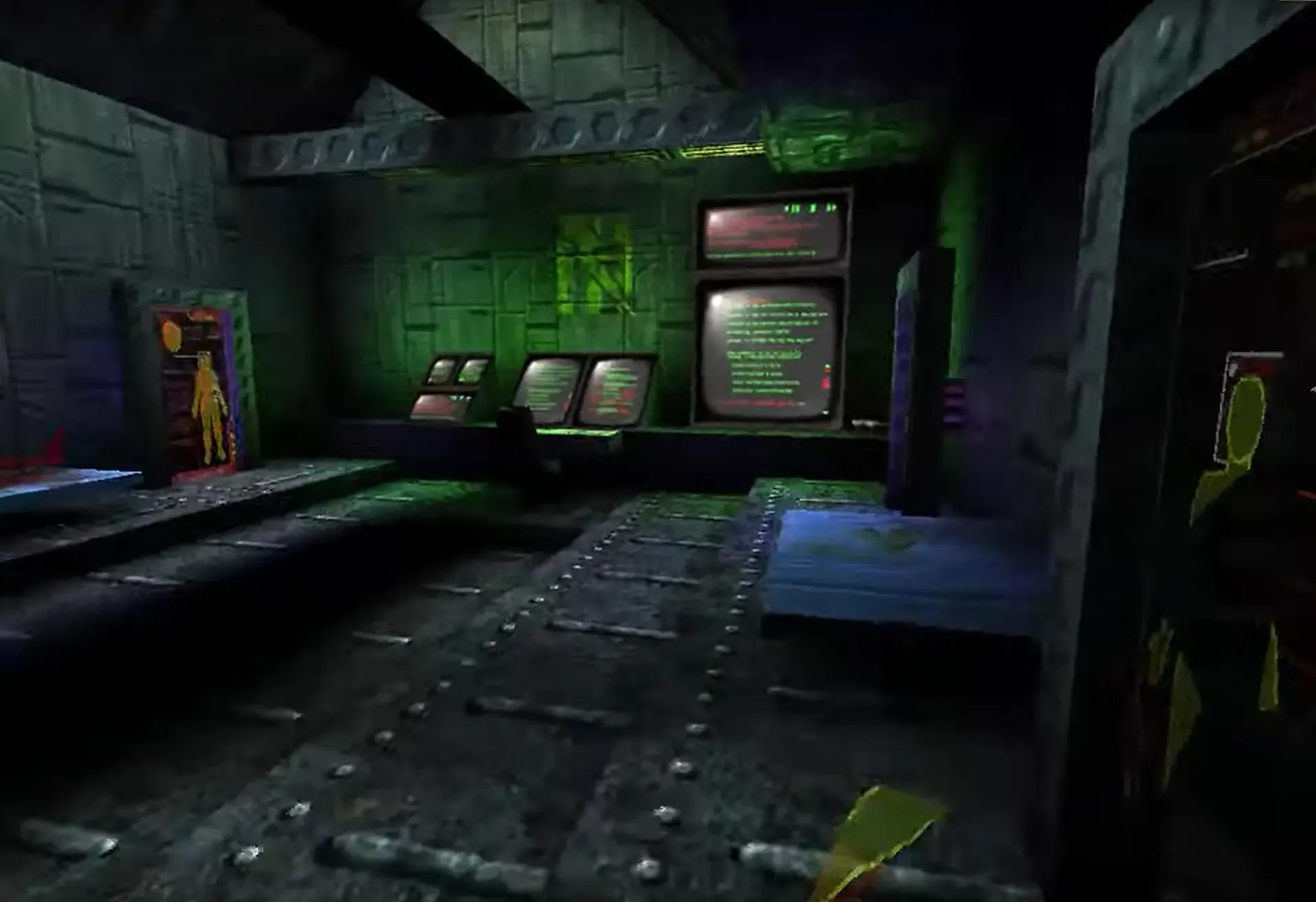
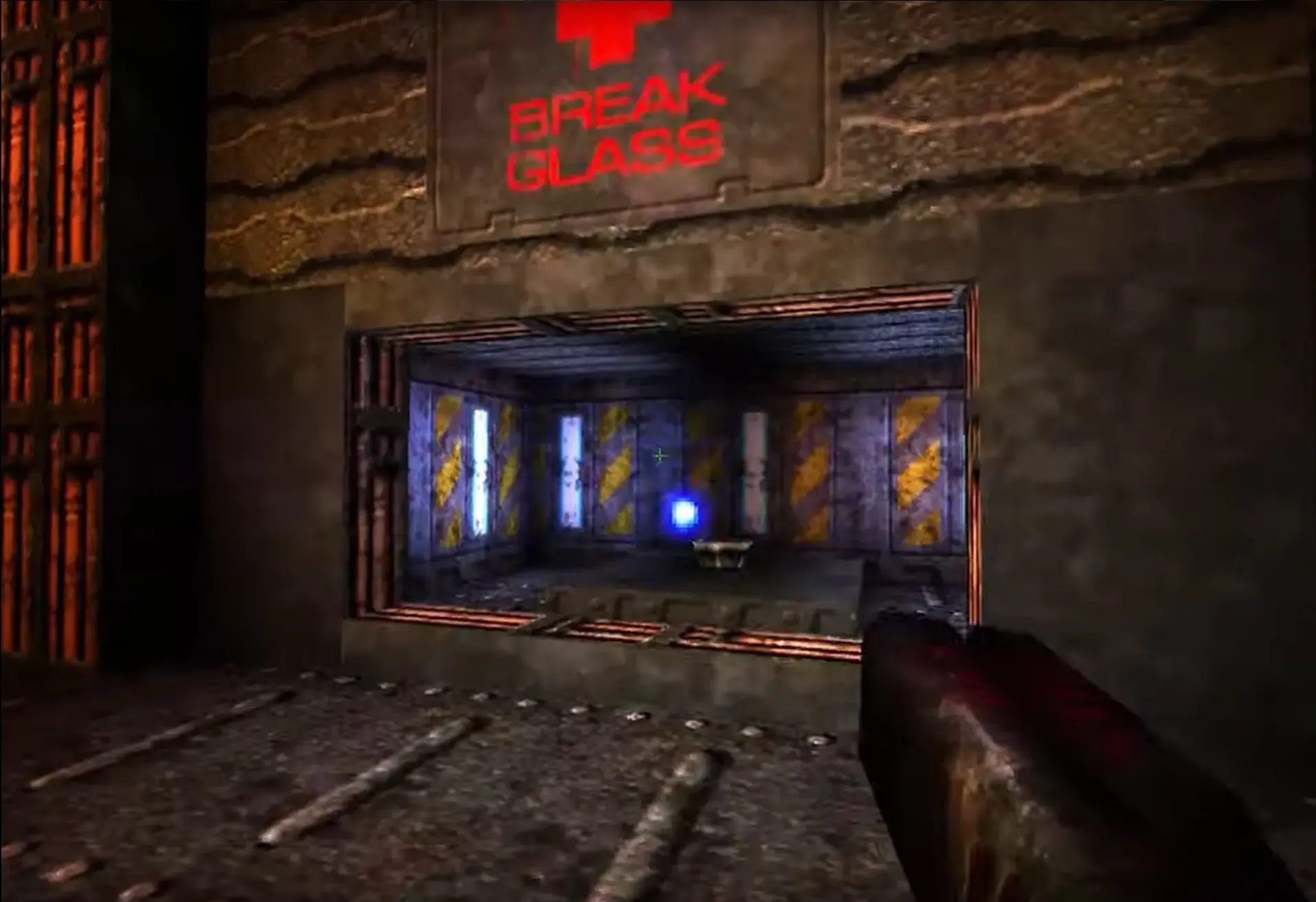
From the intro, with that ruined prison ship, the light filtering through grates, those photo-realistic textures… it was breathtaking.
Players discovered an alien planet, Na Pali, teeming with visual detail. It featured :
- Dynamic weather effects
- Titanic architectures
- Credibly animated enemies (thanks to the Skeletal Animation System)
- Giant maps for the time
And most importantly, it all ran (more or less smoothly) on the machines of the day, with or without a 3D card, which was a technical feat.
Unreal was a shock. A sort of mystical Half-Life, with temples and laser weapons.
— An emotional player on a forum in 2003
The Included Tools : The Revolutionary Editor
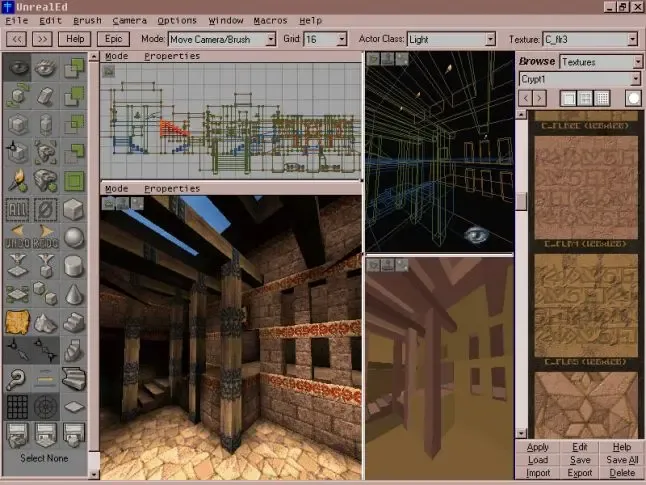
The true stroke of genius was the Unreal Editor (UnrealEd).
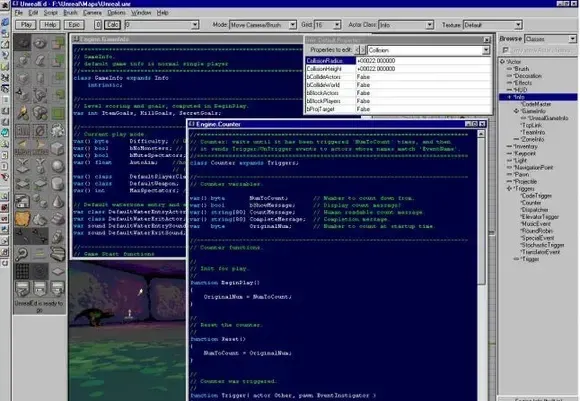
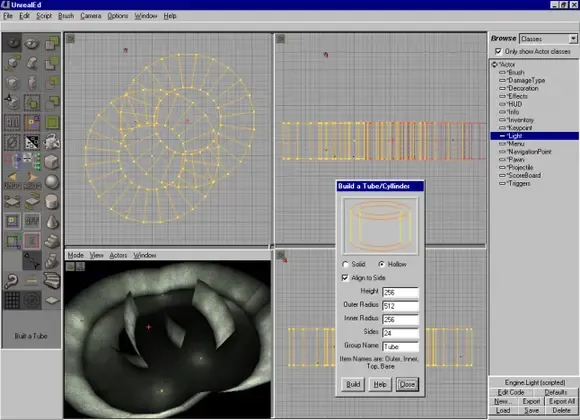
Designed from the start to function in real-time, it was one of the first to offer a fluid and intuitive creation experience. The user drops a light ? It appears. They create a BSP volume ? The rendering updates instantly. Far from the long compiles of QuakeEd, UnrealEd paved the way for freer, more artistic creation.
The interface drew its influences from Visual Basic, Maya, and ZZT (Sweeney’s student game). You found the visual aspect, the scriptability, and the pleasure of "quick testing." The tool allowed for an instant workflow : quads, wireframes, menus, textures, and objects visible in real-time in four distinct viewports.
UnrealScript, meanwhile, allowed developers to code complex behaviors without touching the engine : weapons, AI, triggers, events… everything became possible. Some studios found it so brilliant that they refused to migrate to Unreal Engine 2 later, as the language suited them so well.
- Level creation via a “3D paint” BSP editor
- Add lights, triggers, doors, elevators, scripts
- Test their map in one click
It was one of the first engines to offer an intuitive creation interface for non-programmers.
And to top it off… Epic distributed this editor with the game. Result : an ultra-active modding scene bloomed immediately.
Unreal Tournament : Multiplayer on Steroids
In 1999, Epic drove the point home with Unreal Tournament, often abbreviated as UT99.
- Dedicated servers
- LAN and online matchmaking
- Adjustable AI Bots
- Multiple game modes
- Custom skins
- Infinite modding
UT99 was a phenomenon. Even local LAN parties in 2003 were running UT, with custom maps, insane mods (Rocket Arena, ChaosUT...), and skins of Homer Simpson armed with a flamethrower.
Did you play it ? If so, congratulations : you’re a veteran of UE1. Eternal respect.
Landmark Games Using Unreal Engine 1
Key Games of the Unreal Engine 1 era
The engine didn't just power Unreal and Unreal Tournament. It equipped an entire generation of games :
| Game | Studio | Particularity |
|---|---|---|
| Unreal (1998) | Epic Games | Technical FPS, technological demo |
| Unreal Tournament (1999) | Epic Games | Insane multiplayer, open modding |
| Deus Ex (2000) | Ion Storm | FPS-RPG with stealth, heavily modified |
| Rune (2000) | Human Head Studios | 3rd-person Viking melee action |
| Harry Potter and the Philosopher's Stone | EA | UE1 tweaked for a childish platformer |
| Clive Barker’s Undying | DreamWorks | Gothic atmosphere, supernatural gameplay |
| Wheel of Time | Legend Entertainment | Narrative FPS with spells, unique storytelling |
| Mobile Forces (2002) | Rage Software | Vehicles + FPS, Battlefield-style |
| Tactical Ops : Assault on Terror | Kamehan Studios | UT mod turned full game |
| X-COM : Enforcer (2001) | MicroProse | Arcade shooter very different from the series |
| America’s Army (2002) | US Army | Military recruitment FPS, free to play |
Trivia That Few People Know…
- The Unreal logo (the stylized “U”) was drawn by Shane Caudle, an in-house Epic artist. It’s inspired by Celtic runes and aims to evoke both the medieval and the futuristic.
- UnrealScript was so loved that some studios refused to upgrade to UE2 because of its structural changes.
- Maps in UE1 were stored in .UNR files, which could contain textures, scripts, sounds, triggers… a true container before its time.
- Early versions of the engine used DirectSound and very basic 3D audio rendering… which some modders improved with EAX and OpenAL effects.
- Epic used Delphi to create some of the engine's auxiliary tools. Yes, Delphi.
- There is a version of UE1 compiled for the Dreamcast, never commercially released but used internally.
Legacy and Heritage
Unreal Engine 1 disrupted the industry. It established a new way of thinking about development :
- A modular engine
- A high-level scripting language
- An editor bundled with the game
- A culture of modding
- An accessible commercial license (compared to Quake Engine)
And above all… it trained a generation of developers. Many of them, having started with Unreal, now work at CD Projekt, Arkane, Ubisoft, DICE, Larian, or Epic itself. Their experiences with UE1 shaped their technical thinking.
Without Unreal Engine 1, there would be no Fortnite, no Mass Effect, no BioShock. Because all these titles were influenced — directly or indirectly — by the original engine's architecture.
In Conclusion : An Engine That Changed Everything
Unreal Engine 1 was a vision. A coder’s dream. A promise kept : giving power to creators. Offering emotion and wonder through technology.
It wasn't just an engine. It was a gateway to the imagination, to a 3D world where everyone could create their own legend.
And you... maybe you’ve already played it. Maybe you fragged in Unreal Tournament at a LAN party in 2002, eating pizza ordered 20 minutes earlier, just like we did on our end. We also went through Rune, XCOM, and of course Deus Ex... It was an era.
But maybe you also scripted a bot behavior in UnrealScript at 3 a.m.
Or maybe you’ve just discovered this engine.
Whatever the case : you are now part of this great adventure. And the story continues.
Did you play games using Unreal 1 ? Welcome to the Boomer club ! Tell us everything !