Star Wars Jedi Knight II: Jedi Outcast (2002) - The Greatest Lightsaber Combat in Gaming History
If you have been following our series dedicated to the Dark Forces / Jedi Knight saga, you already know how much these games mean to us here at the Campus. We started with the FPS that changed everything: Dark Forces, followed Kyle Katarn as he embraced the Light Side in Jedi Knight: Dark Forces II, and explored the shadows with Mysteries of the Sith and its explosive duo, Kyle and Mara Jade. Today, we tackle the heavy hitter. The one I have played through three or four times from start to finish, and which remains, in my eyes, one of the best titles in the Star Wars saga across all eras. Star Wars Jedi Knight II: Jedi Outcast, released in March 2002, developed by Raven Software, and published by LucasArts. This game set the definitive gold standard for lightsaber combat in video games—a standard that has never truly been surpassed since.
Available today on Steam and GOG for just a few dollars, it runs on any modern machine with a tiny bit of tweaking, and it honestly deserves to be (re)discovered in 2026. Here is why.
Where Was Kyle Katarn Before Jedi Outcast?
A former Imperial agent turned Jedi, then... nothing
To truly grasp Jedi Outcast, we must look back at where we left him. In Dark Forces II: Jedi Knight (1997), Kyle Katarn learned that his father was killed by Imperial order and that he was Force-sensitive. He faced and defeated the Sith Lord Jerec in the Valley of the Jedi, a site of immense power that Jerec sought to exploit for galactic domination. Kyle faced the choice between the Dark Side and the Light. In the canonical Expanded Universe continuity, he chose the Light.
Then, in Mysteries of the Sith (1998), we learned that Kyle had ultimately renounced his lightsaber and his powers, leaving Mara Jade to step in and save him from a Sith temple. Kyle was afraid. Afraid of himself, afraid of the Dark Side, and afraid of what he might become if the Force remained within his reach. He is not a character who is comfortable with his connection to the Force. This is one of the most compelling aspects of the saga: Kyle Katarn is no saint. He is driven by vengeance, haunted by doubt, and has far more depth than most Star Wars protagonists.
💾 In 12 ABY (After the Battle of Yavin), the New Republic is established, and the Empire has been reduced to pockets of resistance known as the Remnant. Kyle has returned to his life as a mercenary. No lightsaber. No Force. Just him, Jan Ors, the Raven's Claw, and intelligence missions for the New Republic. Back to square one, in a way.
Jedi Outcast begins in this timeline: two years after Mysteries of the Sith. Kyle and Jan receive a routine inspection mission on the planet Kejim. A supposedly abandoned Imperial base. Naturally, things do not go as planned.
The Story: Vengeance, Betrayal, and the Return to the Force
Desann: The most menacing Sith you have ever faced
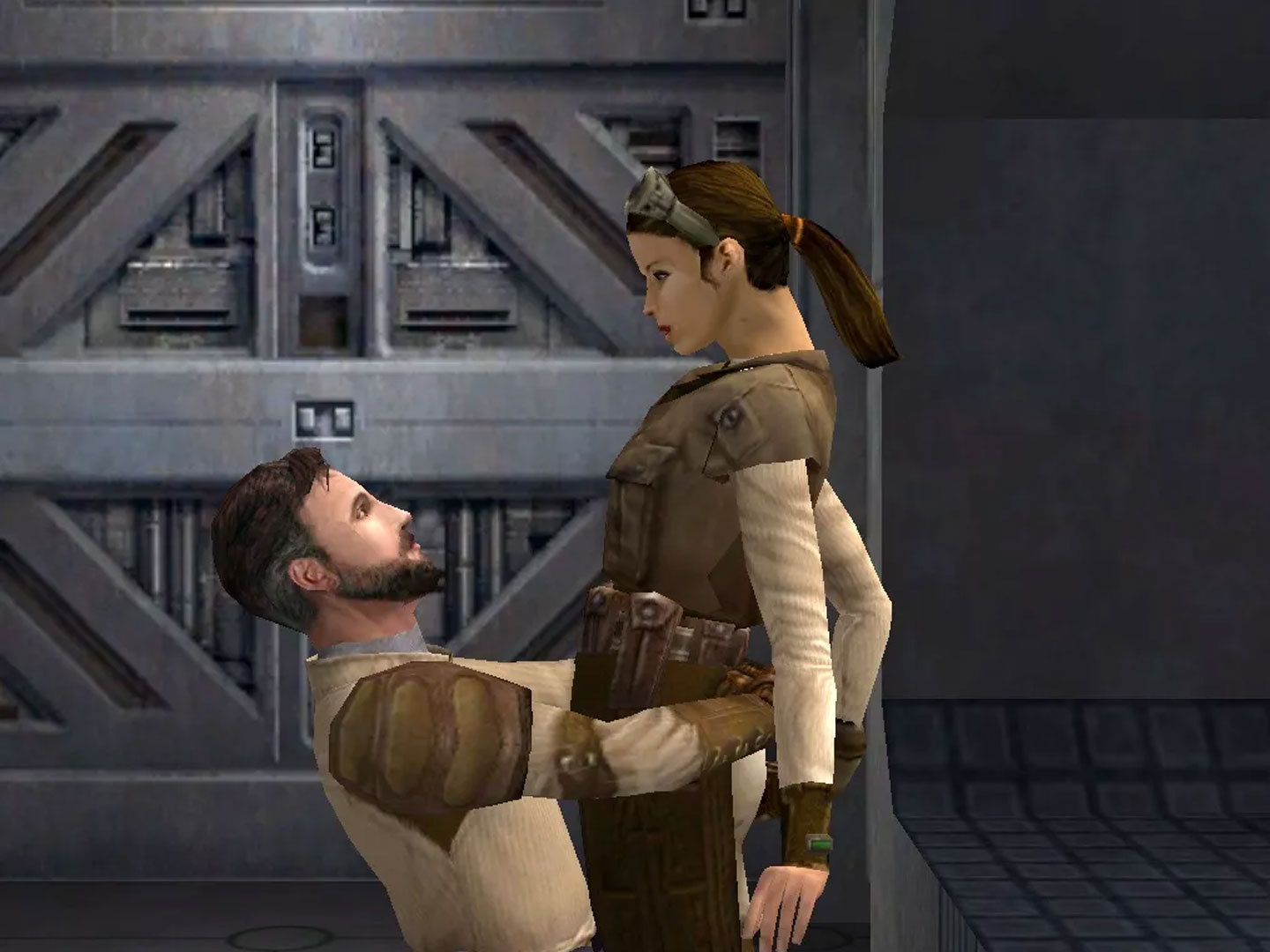
On Kejim, Kyle and Jan discover Imperial soldiers experimenting on Artusian crystals, which are linked to the Valley of the Jedi. They track the lead to Artus Prime, a mining colony turned into an Imperial fortress. Then comes the moment that changes everything. Kyle is captured and finds himself face-to-face with Desann—a former Jedi fallen to the dark side, massive, brutal, and intimidating. Desann kills Jan before his eyes. At least, that is what Kyle believes.
Consumed by rage, Kyle does exactly what Desann expected: he returns to the Valley of the Jedi to draw enough Force power for revenge. In doing so, he unwittingly leads Desann to the sacred site. Desann then imbues his soldiers, the Reborn, with the energy of the Valley, creating an army of Force-sensitive warriors who lack discipline but possess raw power. Jan was alive, used as bait. And Kyle, furious and manipulated, must now fix his mistake, find Jan, and eliminate Desann before he launches a full-scale invasion.
🕹️ Galak Fyyar is the technological mastermind behind the alliance between Desann and the Remnant, aboard his Star Destroyer, the Doomgiver. Tavion, Desann’s apprentice, plays a key role in the scheme by faking Jan’s execution. She reappears later in Jedi Academy, but that is another story. And then there is Reelo Baruk, a crime lord on Nar Shaddaa who serves as a perfectly timed local complication.
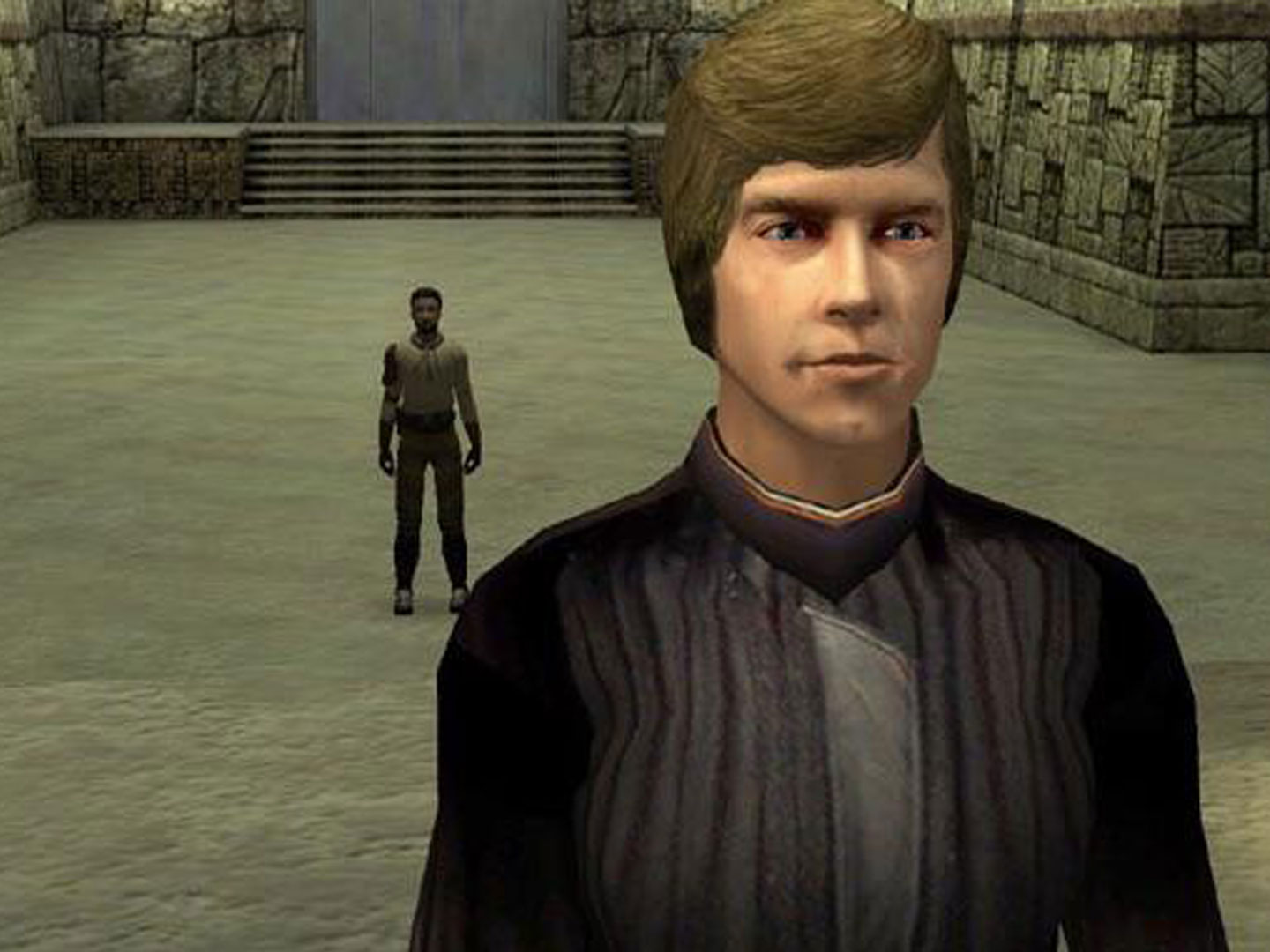
The script works because Kyle is not a passive victim. He creates the problem through his own rage and pride. The game does not absolve him easily. The final confrontation with Desann, who has imbued himself with the power of the Valley of the Jedi to become nearly invincible, results in a tense and brutal duel. Luke Skywalker also appears in the second half of the game, adding a truly epic dimension to the narrative.
Gameplay: FPS Beginnings, Jedi to the Core
The progression toward the lightsaber: Genius or frustration?
This remains a topic of debate even in 2026. Jedi Outcast begins by putting you in the shoes of a mercenary without powers. Blasters, sniper rifles, grenade launchers—the classics. You remain in this state for the first six levels, roughly three hours of gameplay. Some players hated this back then. Personally, I have always found it brilliant.
Why ? Because this phase forces the player to truly learn the levels, use the environment, and understand enemy behavior. Most importantly, it gives immense weight to the moment you finally reclaim your lightsaber on Yavin IV. We would see this principle of deferred power-up in several later games: Knights of the Old Republic and even Star Wars: The Old Republic. It is not just a gameplay upgrade. It is a powerful narrative and emotional milestone. Kyle takes back what he once denied. And then, everything changes.
The lightsaber: Three styles, infinite depth
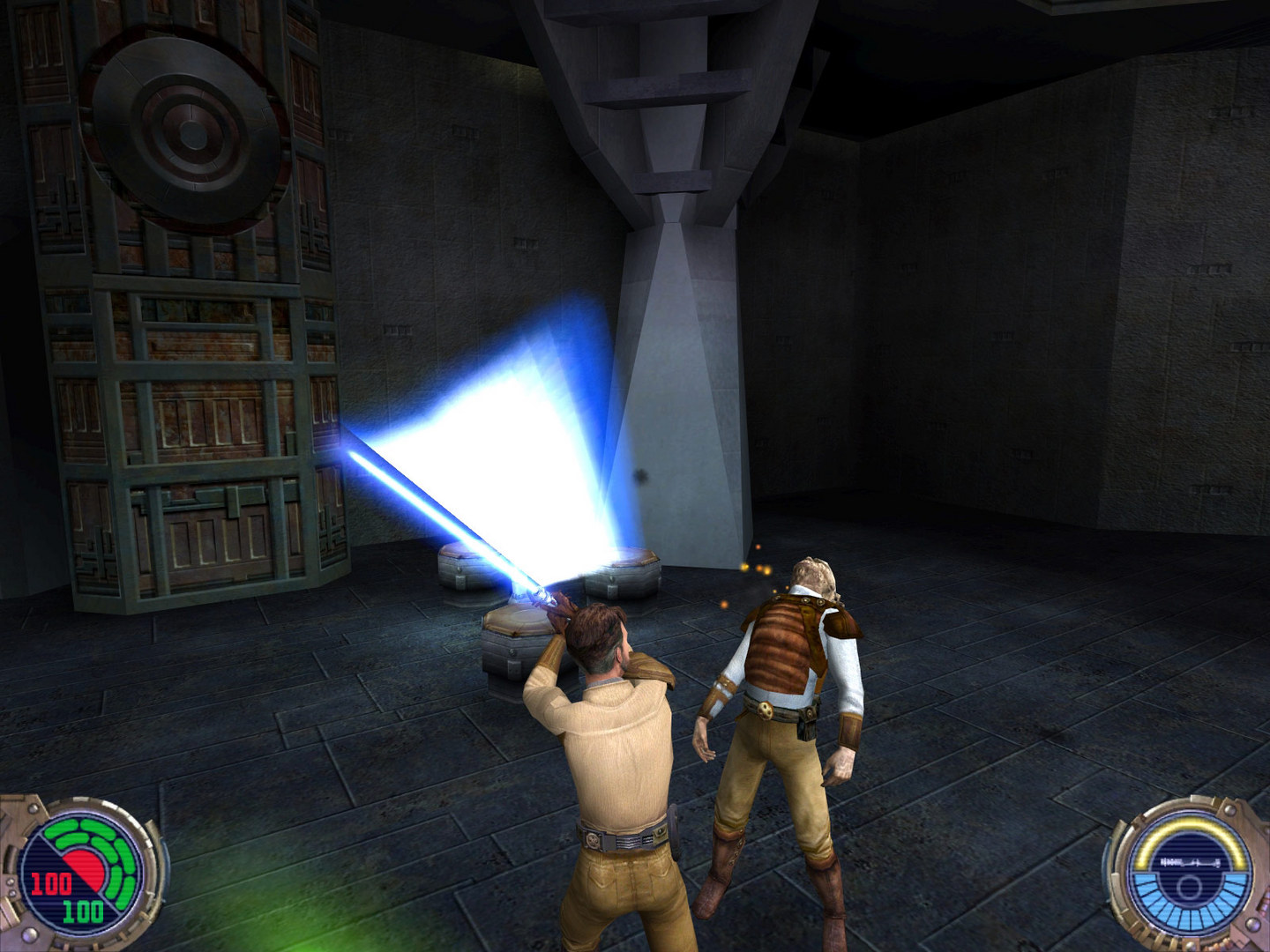
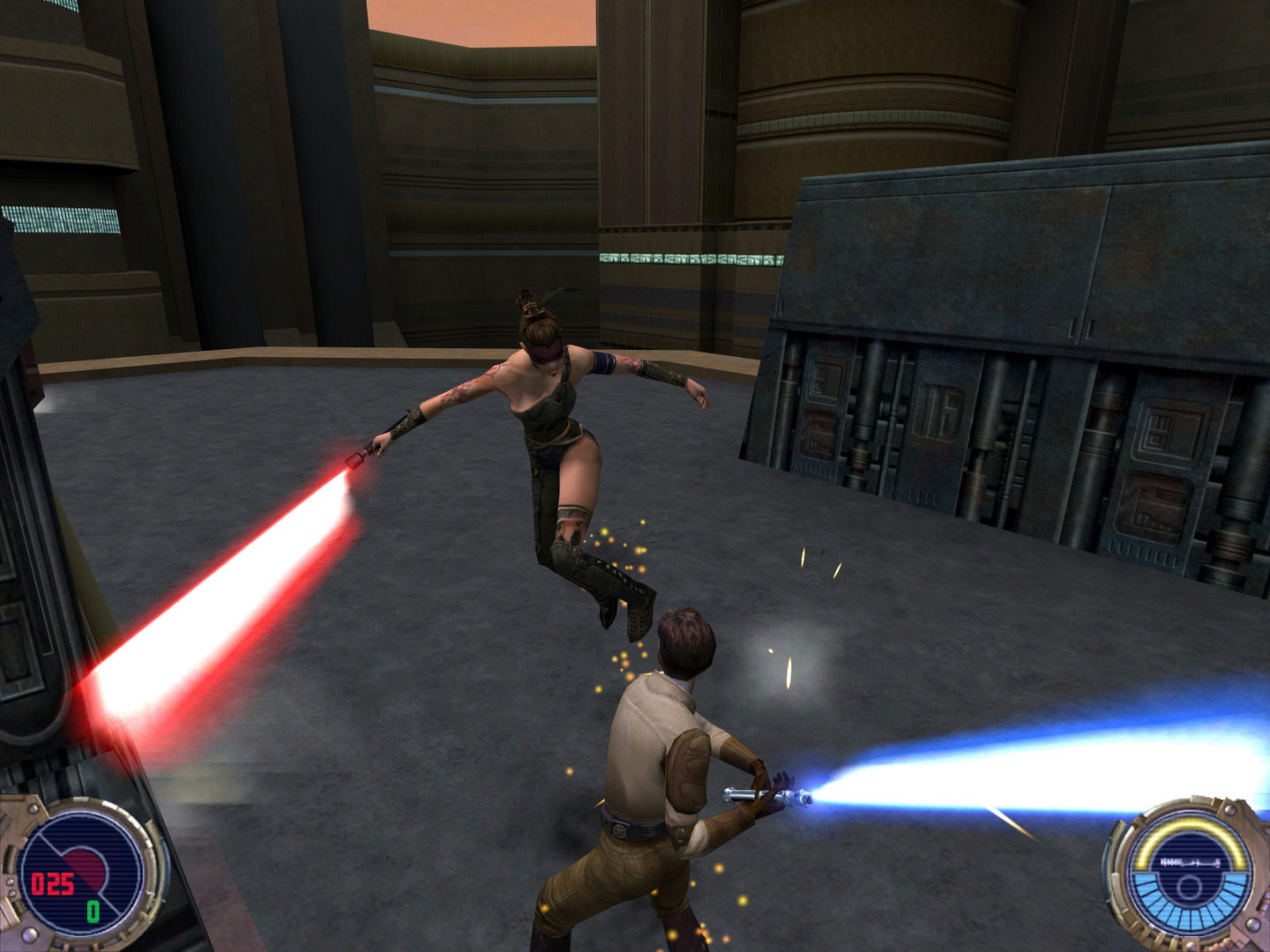
This is where Jedi Outcast becomes something else entirely. The lightsaber combat system by lead programmer Mike Gummelt was inspired by the mechanics of Bushido Blade (1997) on PlayStation—the Japanese sword-fighting game where a single well-placed strike could be fatal. The result in Jedi Outcast is a system where attack angles are dictated by your movement direction, and where three styles of combat offer very different profiles.
- Fast Style : Quick strikes, short range, excellent defense. Ideal against groups of weak enemies, but you must stay very close.
- Medium Style : The balance between speed and power. The starting style—versatile and accessible.
- Strong Style : Slow, powerful, wide range. Devastating against lone opponents, but leaves you completely open between swings.
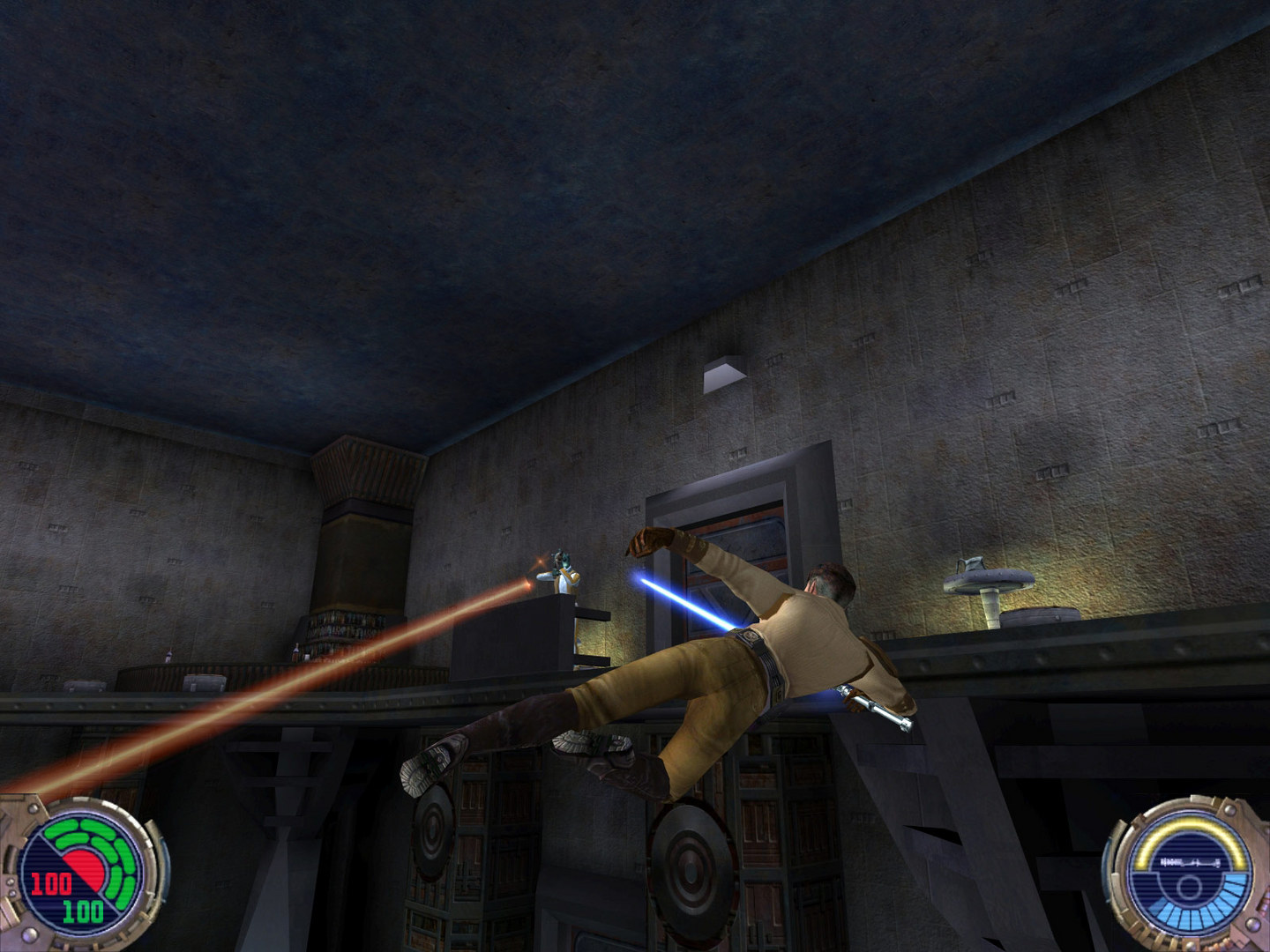
Each style has its own combos triggered by combinations of movement and attack. A player who masters the flow between the three styles can perform feats that leave novices speechless. The competitive community for Jedi Outcast pushed the system to limits that Raven Software likely never fully anticipated: levels of technicality comparable to competitive fighting games, featuring combos, wall-runs, and saber throws used creatively in the heat of a duel. The game has a depth comparable to Smash Bros for its most advanced players.
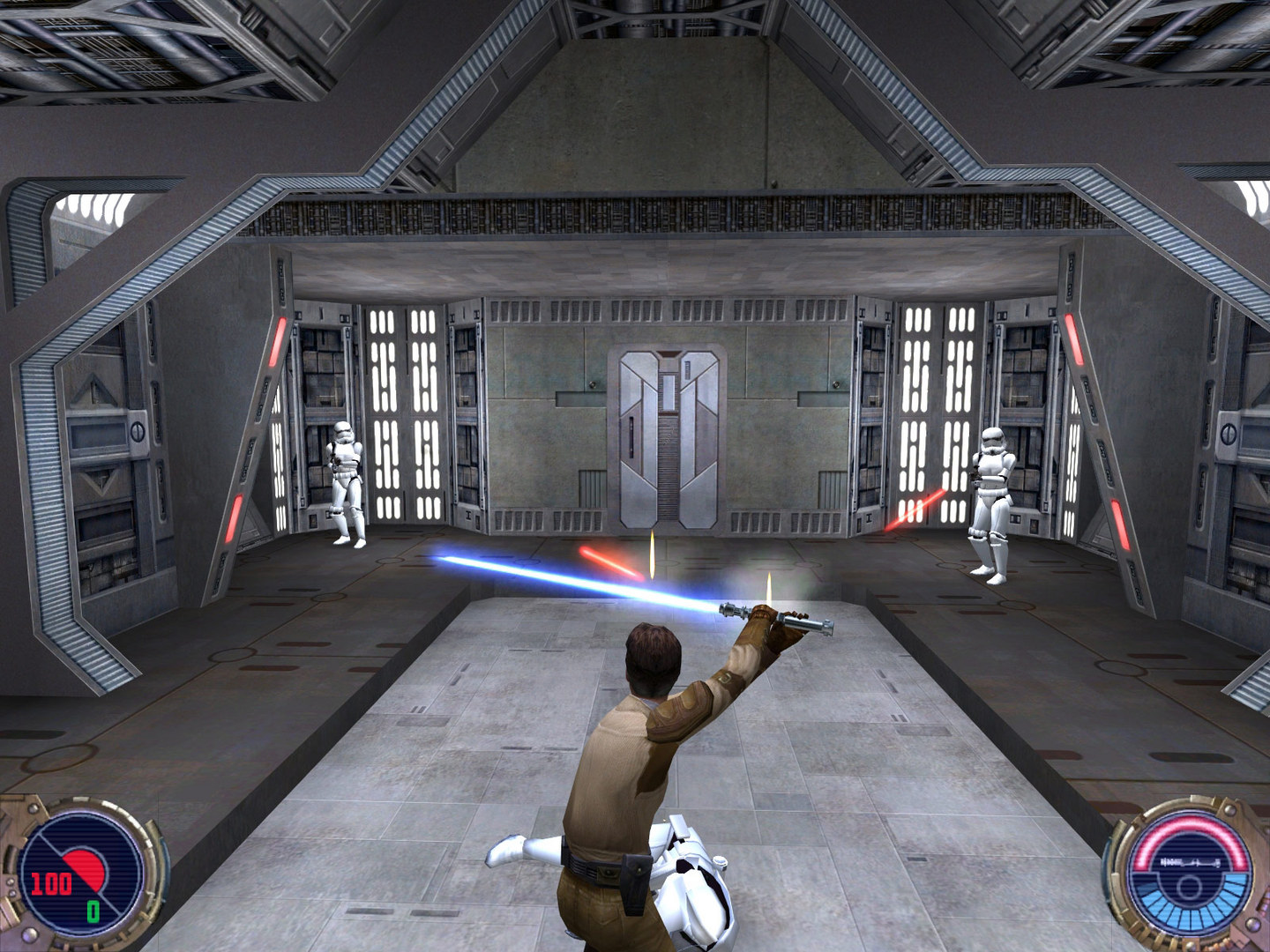
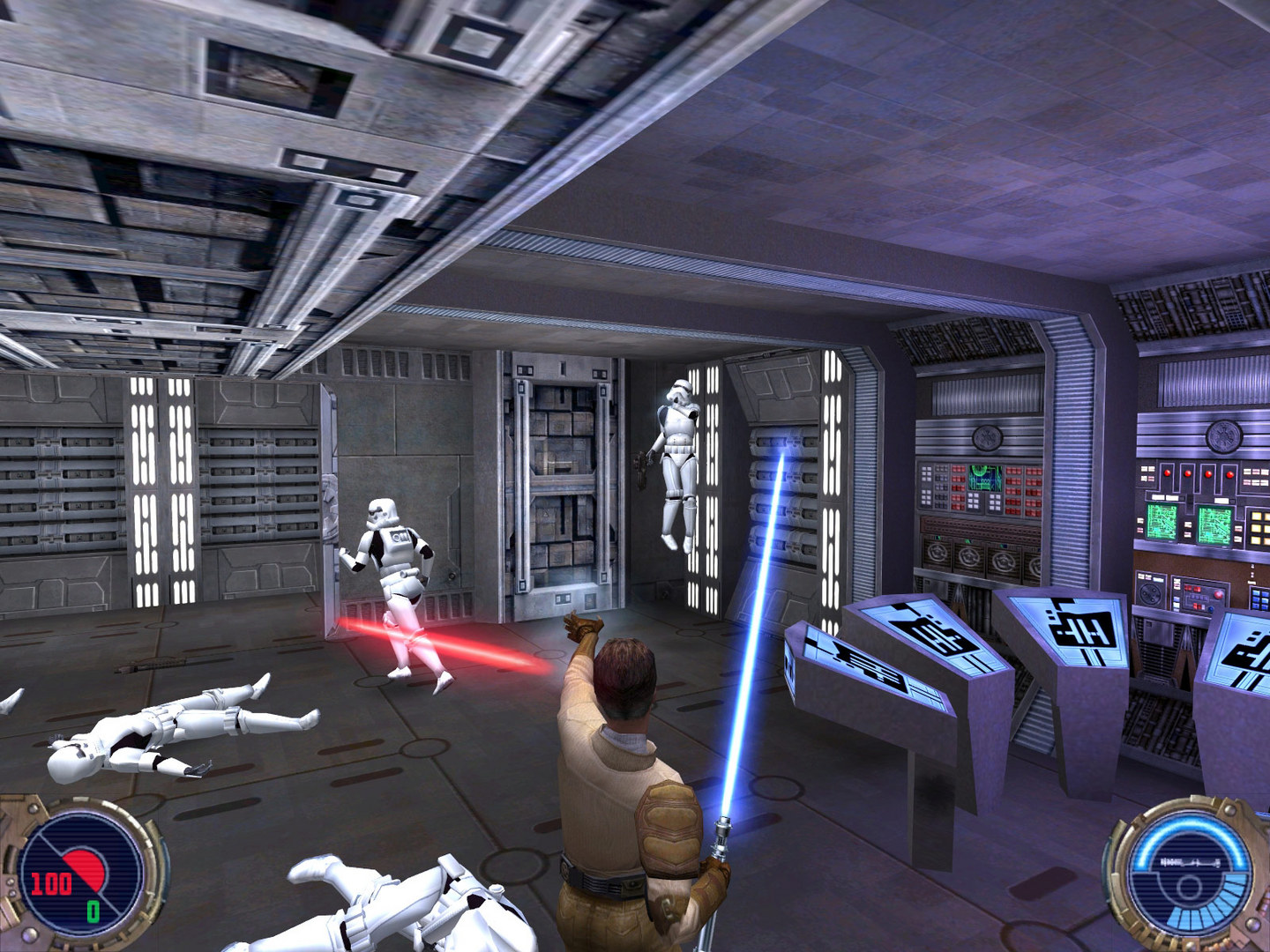
Automatic saber defense deflects blaster bolts, creating memorable moments where you calmly walk toward a room full of stormtroopers, batting away their fire. The command g_dismemberment 11381138 allowed for realistic dismemberment physics, turning duels into something truly visceral. This was 2002. Raven Software was not playing around.
Jedi Outcast did not just put a lightsaber in your hands. It gave you a system to master, not just to use. This is why no one has truly managed to do better since.
Force Powers: Light, Dark, and Freedom
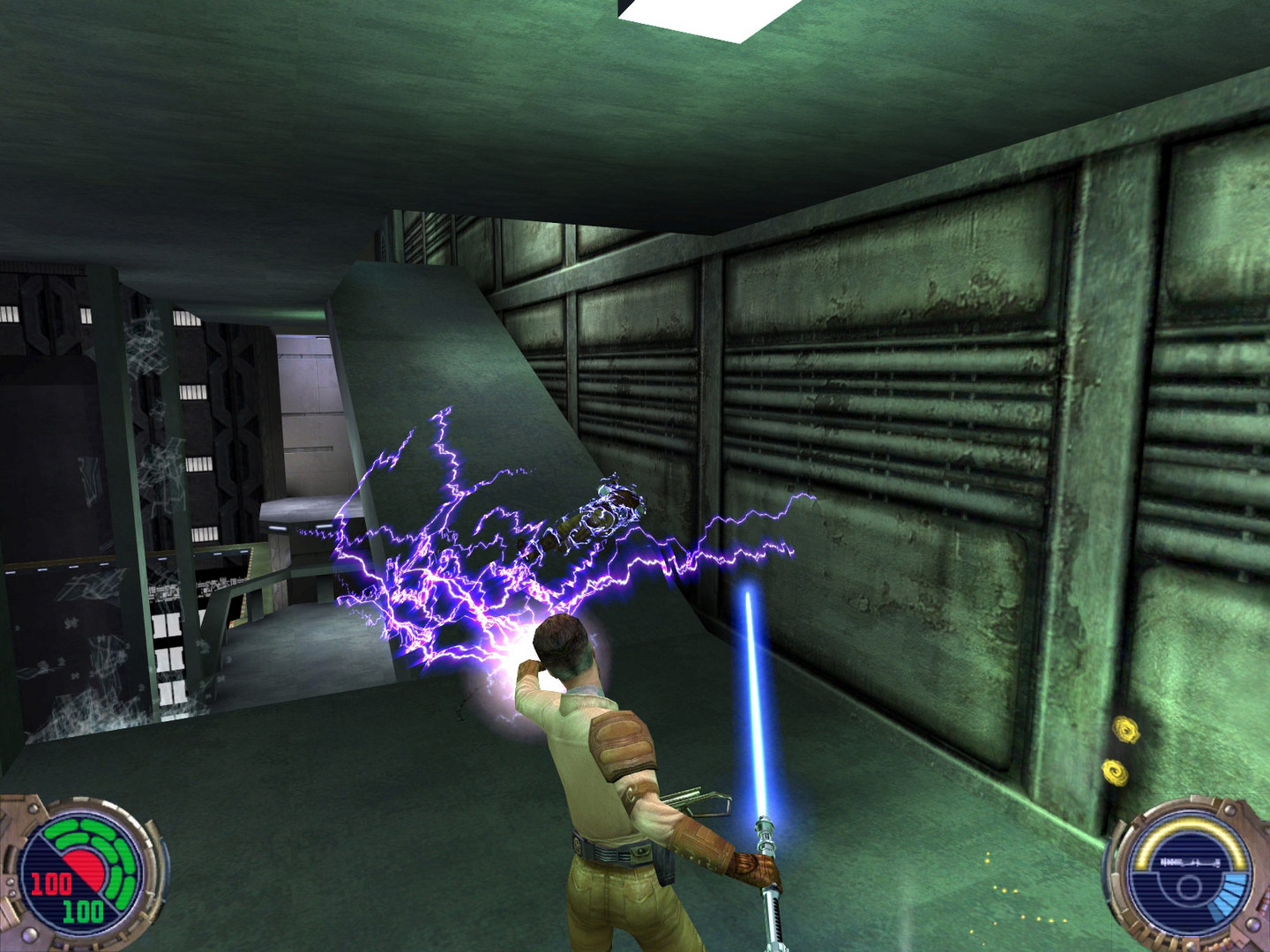
Force powers are divided into neutral, Light Side, and Dark Side. Unlike previous installments, Jedi Outcast does not force you to choose a moral alignment in the skill tree. You unlock powers as the story progresses, and certain levels automatically unlock the abilities needed to advance. Essentials include: Force Push (sending enemies into the abyss—one of the game’s purest joys), Force Pull (ripping an enemy’s weapon away), Force Speed (tactical slow-motion), and on the Dark Side, Force Grip (distance choking), Force Lightning, and Dark Rage.
The combination of Force Push and a well-placed cliff remains one of the most satisfying experiences gaming has ever provided. I have played this game three or four times, and that feeling never gets old.
The Technical Revolution of 2002
The Quake III engine, adapted and transcended
Raven Software built Jedi Outcast on the id Tech 3 engine, the foundation of Quake III Arena, but heavily modified. The visual result was impressive for its time: vast environments, dynamic lighting effects, and characters with double the polygon count of the original engine's standards. The PC requirements in 2002 were roughly a Pentium III 600 MHz, 128 MB of RAM, and a GeForce 256. Today, it runs on any machine built since 2005.
The most significant technical innovation was the GHOUL2 system, a skeletal animation engine developed by Raven that allowed for real-time mesh deformation. Practically, this meant fluid, readable combat animations and made the famous dismemberment system possible. Enemies reacted differently depending on which body part was hit. In 2002, seeing a stormtrooper lose a limb from a well-placed saber strike was something players had never seen at this level of quality.
The hybrid FPS/TPS camera system was also a true innovation: first-person view for ranged weapons, and an automatic switch to third-person for saber combat. This duality existed in Jedi Knight: Dark Forces II, but Jedi Outcast perfected it and made it feel natural. You can even force the first-person view with the saber, something that was actually not possible in Jedi Academy.
💡 To play in 2026 under the best conditions : The game is available on Steam (App ID 6030) and GOG for less than 5 dollars. On Windows 10/11, the community-recommended solution is OpenJO, the open-source port maintained by the JACoders, available on jkhub.org. It fixes crashes on modern hardware, supports high resolutions, and improves overall stability. Place the files in your GameData folder. For multiplayer, JK2MV is the reference in 2026.
Level Design: A Lesson in Variety
From Kejim to the Death Star via Cloud City
What strikes you when (re)playing Jedi Outcast is the incredible variety of environments. Kejim and its icy Imperial bases, Artus Prime and its oppressive mines, the dark and grimy streets of Nar Shaddaa, the classic grandeur of Yavin IV, the dizzying walkways of Cloud City on Bespin, and the cold industrial efficiency of the Doomgiver. Each zone has a strong visual identity and its own spatial logic.
The game is not an open world—it is linear—but the levels are large and well-constructed enough that you will find yourself searching for secret passages, hidden ammo, and optional areas. Puzzles are present, never too obtuse, and often solved through creative application of Force powers. Force Push to move a heavy object, Force Grip to pull a distant switch... the level design and mechanics are in constant dialogue.
One level remains etched in the memory of everyone who played: Nar Shaddaa, the first level after reclaiming the saber. Raven greets you not with easy-to-kill stormtroopers, but with a swarm of Rodian snipers who can kill you in one or two shots. It is a reality check right after your expected power surge. And it works, because it immediately teaches you that the saber is not a universal solution.
Multiplayer: A Culture Unto Itself
Servers, Honor, and a Community That Has Lasted 23 Years
Jedi Outcast had a robust multiplayer for its time: Deathmatch, Team Deathmatch, Capture the Flag, and Duels. Built on the solid networking foundation of the Quake III engine, online play functioned well and was accessible via LAN or the internet. On consoles (Xbox, GameCube), it was limited to two players, but on PC, it was something else entirely.
This multiplayer developed a very specific culture of honor. "Roleplay" or "Honor" servers appeared where players would greet each other by bowing with their sabers, refused to attack an opponent with their saber turned off (saber down), and practiced formalized duels with spectators. These unwritten codes were enforced as strictly as official rules. It was something you simply didn't see anywhere else.
In 2026, the community is still here. JK2MV maintains a multiplayer service with active servers, allowing play on versions 1.02, 1.03, and 1.04 of the game, each having gameplay nuances distinct enough that veterans have their preferences. The site JKHub centralizes mods, maps, skins, and community resources. All this, 23 years after the game's release.
Conclusion: A 24-Year-Old Game That Remains Unsurpassed
I have played through it three or four times. And each time, the same thing happens: the first few hours of pure FPS gameplay remind me why this game is so well-constructed in its progression, then the return of the saber on Yavin IV gives me that same adrenaline rush, and the duels against the Reborn in Cloud City remind me why no one has done it better since. Jedi Outcast is 24 years old this year, and its lightsaber combat remains a benchmark that modern games still cite without ever truly matching it.
This is not blind nostalgia. It is a fact: Mike Gummelt’s system—with its freedom, technicality, and accessibility coupled with a nearly infinite skill ceiling—is timeless game design. In a Star Wars universe currently experiencing a fascinating period with projects like Zero Company and numerous upcoming releases, it is good to remember where the high standard we hold for Star Wars games comes from.
If you have never played Jedi Outcast, you have five dollars and an afternoon to invest. If you played it back in the day and haven't touched it since, I hope this article has made you want to dive back in. And if you want to continue Kyle Katarn's story, Jedi Academy is waiting, with an even deeper saber system. We will get back to that.
💡 Broad Star Wars fan ? We have prepared the ultimate guide to upcoming Star Wars films and series (2026-2030 edition). And if you are looking for all the Star Wars games coming soon, our recap Star Wars Gaming : Toward a New Era of Masterpieces is for you.
How did you experience Jedi Outcast back in the day ? Was it on an old family PC struggling at 30 fps, or did you discover it later ? Tell me all about it in the comments !