OpenAI : did the heist of the century on global RAM kill PC gaming?
The wake-up call is "a bit tense" for technophiles in early 2026. If you’ve tried to update your PC config in recent months, you’ve undoubtedly flinched at your Amazon or Newegg cart. A simple 32GB kit of DDR5-6000, which was trading for $140 not long ago, is now nearing $400. Yes, it hurts, and no, this isn't the end of the tunnel. At the heart of this chaos : a maneuver by OpenAI and its charismatic leader, Sam Altman, which looks more and more like a devastating poker move for the consumer market.
In October 2025, in total secrecy, OpenAI signed letters of intent with South Korean giants Samsung and SK Hynix. The goal was to secure 900,000 DRAM wafers per month for the titanic Project Stargate. The problem is that this volume represents 40 % of global production. Until then, one could say "everything is fine." EXCEPT ! No firm purchase order was ever signed. OpenAI literally "locked" the market with promises, causing systemic panic. This situation unfortunately confirms our fears from the beginning of the year, when we shared that bad news about the RAM shortage that was starting to paralyze the campus.
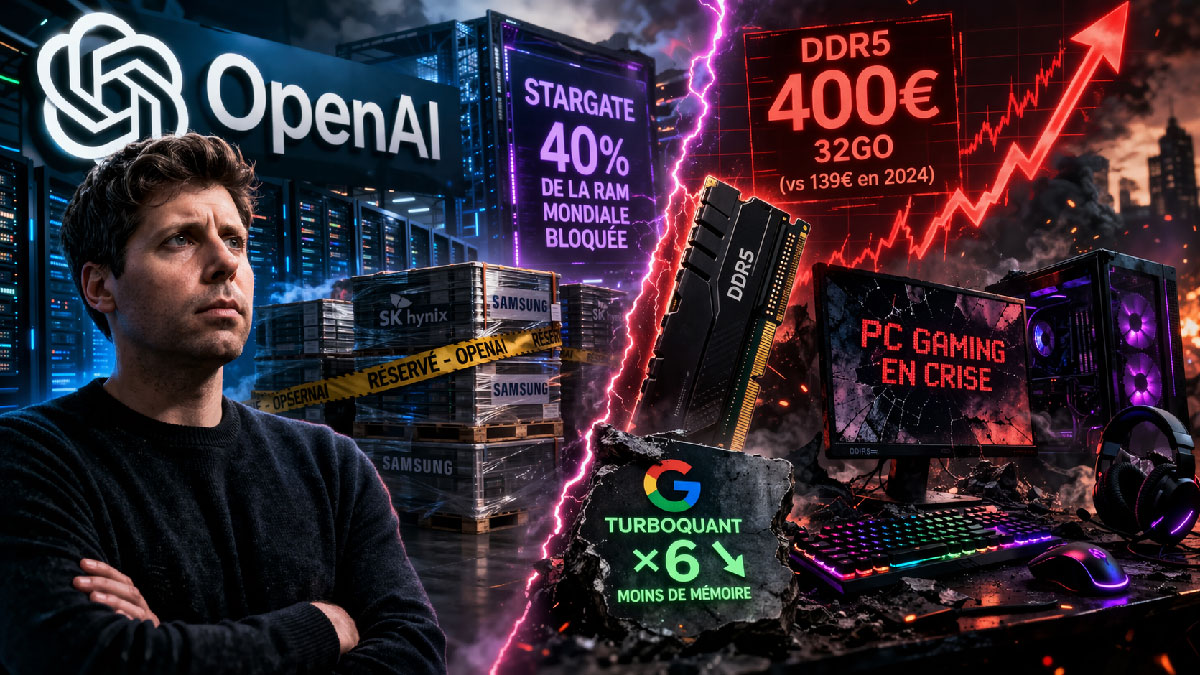
SAM ALTMAN'S "RUG PULL" : 40% OF GLOBAL RAM EVAPORATED
The story is worthy of a financial thriller. Sam Altman traveled to Seoul to sign simultaneously with the two industry leaders, without one knowing what the other was signing. By dangling the prospect of absorbing 40 % of the global capacity estimated at 2.25 million wafers, OpenAI paralyzed distributors. The latter, fearing a total shortage, stopped displaying their prices or applied indecent margins.
But as Grummz (Mark Kern), an influential industry figure and former Blizzard executive, points out, the situation is dramatic for manufacturers who believed in the mirage. Micron, for example, took the radical decision to close its historical brand Crucial, present since 1996, to devote 100 % of its production lines to AI servers, pushing us—the loyal gamers since day one—aside.
Micron shares are in free fall this week.
— Grummz (@Grummz) March 30, 2026
- Be Micron.
- Get excited about Sam Altman singing letters “intending” to buy 40% of DRAM.
- Close your entire Crucial consumer memory division so you can sell gamer RAM to OpenAI.
- Sam Altman loses investors, never buys the RAM he… pic.twitter.com/SNcSSVaIr6
Today, with a Stargate project whose funding is wavering, we better understand the tensions behind the scenes, notably between NVIDIA and OpenAI where the 100 billion discord weighs heavily on the future of global hardware.
Imagine closing your entire consumer memory division because this guy signed a non binding letter that he would buy 40% of the world’s RAM.
— Grummz (@Grummz) March 30, 2026
Only to have him rug pull 3 months later. pic.twitter.com/FdggQR0sx1
THE IMPACT ON YOUR SETUP : THE END OF THE BUDGET PC?
Gartner's figures for 2026 are cataclysmic : a 10.4 % drop in PC shipments is expected. RAM now represents 35 % of the total manufacturing cost of a computer, compared to about 15 % in the past. This price surge directly impacts the components we cherish :
- Steam Deck : Valve has confirmed a global shortage, unable to secure chips at a decent price.
- Gaming Laptops : Brands like Framework have had to increase their prices by 50 % on memory options.
- Entry-level : The sub-$450 PC segment is disappearing, transforming high-performance computing into a luxury product.
TURBOQUANT : THE SAVIOR FROM GOOGLE?
While the DRAM market was on fire, an announcement from Google Research on March 24, 2026, acted as a cold shower for Samsung and SK Hynix. Their new algorithm, TurboQuant, promises to reduce the memory requirements of AI systems by a factor of 6, without performance loss.
If this KV cache compression technology goes mainstream, OpenAI's vital need for millions of wafers could collapse. It’s a fascinating paradox : software optimization could finally calm the insatiable hunger of AI hardware. However, history has taught us that every efficiency gain is often used to run even heavier models. For now, DDR5 prices only dropped by 7 % in March, remaining four times higher than 2024 levels.
🕹️ Technical Note : RAM prices remain extremely volatile. The 7 % gain recorded in March is a first breath of fresh air, but we are still far from returning to balance for building a well-rounded config.
TOWARDS A RETURN TO NORMAL FOR PLAYERS?
For us gamers and content creators, the pill is bitter and hard to swallow. We are paying the price for AI speculation that hasn't even borne concrete fruit for the general public yet. Shares in Micron and Sandisk are in freefall, as investors fear the AI "profit peak" is already behind us.
If you’re building a PC config in 2026, the advice is clear : don't neglect your RAM speed, but perhaps wait for the stabilization promised by the arrival of new production capacities in 2027. The current crisis proves that a simple tweet or a poorly calibrated letter of intent can bring 30 years of the hardware industry to its knees. I don't know if you realize the impact of his move, but it is colossal.
The PC market is going through its greatest existential crisis. In the hands of a few giants like OpenAI, RAM has become the oil of the 21st century, and we are the first to suffer its shortage.
And you, have you had to postpone buying your new configuration because of the price of RAM? Do you think PC gaming can survive such AI dominance over components? We look forward to your thoughts in the comments just below!