The AI Rebuilding Games Without Asking Permission
Since GTC 2026, the world of video games has been in turmoil. NVIDIA presented its DLSS 5, a major evolution of its AI scaling engine, but the reception is far from what Jensen Huang hoped for. Between "technological miracle" and "artistic disguise," the industry is torn over certain practices. And for good reason : for the first time, a consumer technology is capable of transforming the final image of a game after the artists have created it, sometimes without even warning them.
What was supposed to be a simple performance update has turned into a true ideological bombshell. Welcome to the era of semantic rendering, where AI no longer just fills in missing pixels, but reinvents what it thinks it should see.
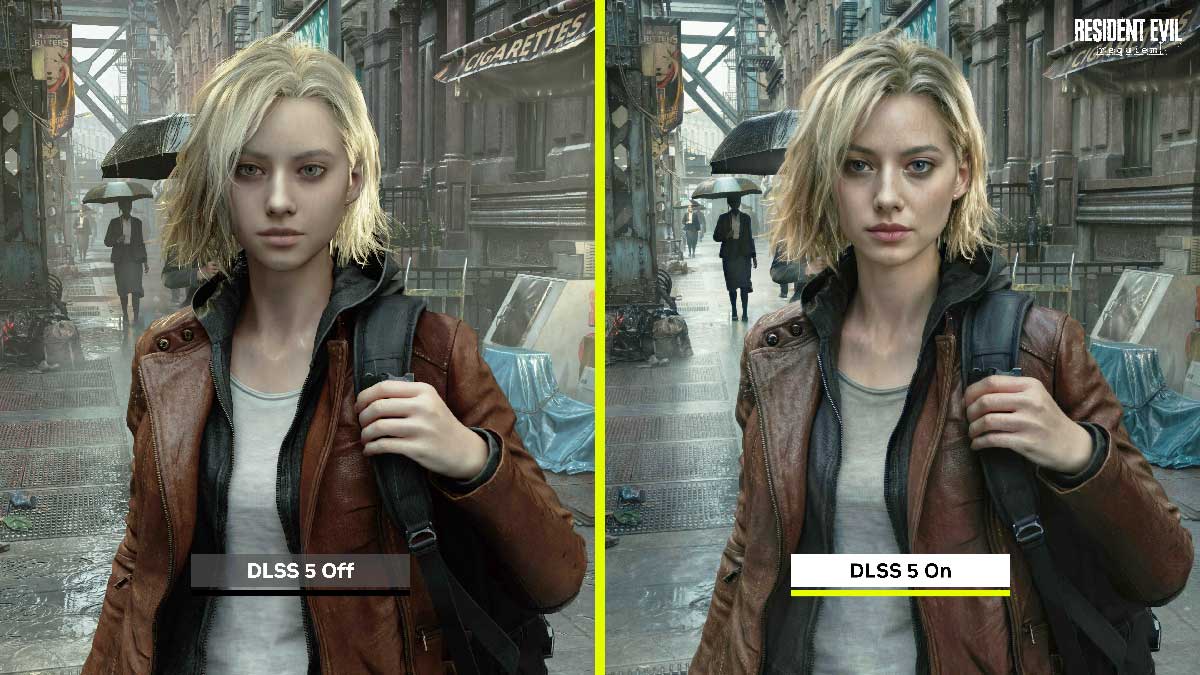
DLSS 5 : When AI Shifts the Paradigm
From Pixel Reconstruction to Semantic Analysis
Until now, DLSS had a simple and well-defined role : to reconstruct a high-resolution image from a native low-definition render, gaining performance without sacrificing too much visual quality. Useful, efficient, widely adopted. With DLSS 5, NVIDIA radically shifts the paradigm and enters the era of scene semantics.
AI is no longer used as a mere sharpening filter. It now analyzes the nature of materials (skin, silk, hair, metal) and injects photorealistic lighting in real-time, in less than 16 ms. Jensen Huang compared this leap to the invention of programmable shaders in the early 2000s. An ambitious analogy. Perhaps too much.
🕹️ What is a programmable shader ?
In the 2000s, graphics cards moved from fixed pipelines (every pixel treated the same way) to customizable programs that developers could write themselves. This revolutionized real-time rendering. NVIDIA places DLSS 5 at the same level of impact, claiming that AI now replaces part of the artistic work of lighting teams.
Yet, this "photorealism" imposed by Silicon Valley doesn't please everyone. And that's where things get interesting, or depending on which side you are on, frankly worrying.
The Bad Buzz : When AI Denatures the Work
The "Instagram Filter" Effect Derailing Social Media
Social media ignited as soon as the first demonstration videos were broadcast. The reason : excessive smoothing and a particularly striking uniformization of visuals. In Resident Evil Requiem, the character of Grace looks like she stepped out of a Midjourney-generated advertisement. Leon suddenly loses 20 years, and skin pores disappear in favor of an artificial "glossy" render that kills the heavy atmosphere Capcom carefully built.
The artistic betrayal denounced by many players and developers is real : DLSS 5 crushes the original artistic direction of games. Regardless of the engine (RE Engine, Snowdrop, Northlight), the final render ends up looking the same. Boosted contrast, modified saturation, and a "clean" vibe that sometimes kills horror or cinematic grain. The meme festival was quick to follow. Razer and Logitech even joined in, comparing office mice to actual rodents to mock this forced realism. You've probably already seen them on your feeds.
Developer Unease : Ubisoft, Capcom, and Devs Left in the Dark
This is the shock revelation from Insider Gaming : some creative hubs at NVIDIA's partners reportedly discovered the DLSS 5 demos at the same time as the public. "We found out along with everyone else," confides a Ubisoft employee. At Capcom, the unease is palpable. The publisher has historically slowed the use of generative AI on its creative projects.
Seeing Resident Evil Requiem transformed by an algorithm without the direct approval of lighting artists or directors poses a crucial question : who truly controls the final image ? There seems to be a deep divide between marketing departments signing tech deals and creative teams shaping the games. Developers spent months building assets from scratch, but before publication, management applied this new "DLSS 5 filter" which modified their entire body of work. And the cherry on top : they weren't even warned.
⚠️ A Dangerous Precedent
If this practice becomes normalized, artistic teams could find themselves creating assets "blindly," without knowing what their work will actually look like in the final product. This fundamentally challenges the integrity of the creative process in the video game industry.
A Chilly Reception : Numbers That Don't Lie
Historically Low Approval Rates on YouTube
The numbers speak for themselves and are particularly telling for an announcement supposed to revolutionize real-time rendering. On official NVIDIA GeForce channels, approval rates are hitting record lows :
- Official Reveal Trailer : only 16.3 % positive reviews.
- Resident Evil Requiem : 14.9 % likes.
- EA Sports FC : 14.5 % likes.
NVIDIA is trying to reassure by explaining that DLSS 5 is a generative control tool and not just a filter to be endured, and that studios will be able to adjust "sliders" to dose the effect according to their artistic needs. But this promise may arrive too late to heal the image of an announcement that clearly missed its mark in communication.
Confirmed Games for Autumn 2026
NVIDIA announced an initial wave of about fifteen titles, noting a very strong presence of Asian studios (NetEase, Tencent), early adopters of AI technologies. Confirmed titles include :
- Assassin's Creed Shadows (Ubisoft) : the latest installment in the historical saga will receive its AI optimization patch shortly after release.
- Starfield (Bethesda) : billed as the most stunning demonstration, the game reportedly simulates a look close to Path Tracing without activating the resource-heavy option.
- Hogwarts Legacy (Warner Bros. Games) : a profound transformation is planned for the materials and character textures of the school of witchcraft.
- Resident Evil Requiem (Capcom) : despite debates over Grace's face, Capcom's flagship title remains a pillar of NVIDIA's technological demo.
- EA SPORTS FC (EA Sports) : the football simulation will focus on player skin realism and more immersive stadium lighting.
- The Elder Scrolls IV : Oblivion Remastered (Bethesda / Virtuos) : the return of this classic will benefit from AI power to modernize its aging visuals.
Progress at Any Cost ? The Campus View
We remember the chaotic beginnings of DLSS 1 in 2019 and its infamous "vaseline effect," before DLSS 2 became absolutely indispensable in every PC gamer's toolkit. But here, the debate is no longer technical. It is aesthetic and ideological, even if we cannot deny another step forward in the quest for absolute photorealism and the raw power of artificial intelligence. By approaching a "Hollywood" look, NVIDIA pushes the limits of what a graphics card can produce in 16 milliseconds.
The flip side is that by turning every game into a shiny but potentially impersonal tech demo, NVIDIA risks turning developers into mere "AI adjusters." If DLSS becomes a crutch to compensate for a lack of optimization (as we already see too often with games released unfinished), the entire visual personality of our favorite games could end up in the museum of industrial failures. It feels like a new branch of developers will have to start repositioning themselves, creating their own independent studios, perhaps for their own good and ours.
Dave Filoni said about Star Wars : "We are truly creating cinema." We hope that video games won't end up creating "truly Midjourney."
What do you think ? Is DLSS 5 a revolution or a threat to the artistic direction of games ? Feel free to talk about it in the comments just below !
💡 Join the community !
Want to discuss games, find friends to play with, or share your pop culture favorites ? Join us on the Little Big Campus Discord 👾