A Black Tuesday for Big Blue
There are days when the stock market is completely unforgiving, and this particular Tuesday will remain forever etched in IBM's history. The American giant, the very company that witnessed the birth of the PC and sold millions of mainframes, lost 25% of its value in a single trading session. Personally, I have seen quite a few tech crashes since I started following this industry, and this one has a very unique flavor : zero scandals. Zero product bugs. We are simply witnessing massive amounts of money changing destinations. And that destination is pure silicon.

A Warning That Already Smelled Like Smoke
🕹️ Key Takeaways
- IBM stock plunges by 25%, the worst trading session since at least 1972
- Global revenue hits $17.2 billion, entirely missing market expectations
- Clients are heavily redirecting their budgets toward AI hardware, leaving IBM software and mainframes behind
CEO Arvind Krishna did not wait for the official earnings release, scheduled for July 22, 2026, to warn everyone. A week prior, he sent an open letter to investors to prepare the ground. And honestly, when a boss brings out the heavy preventive communication artillery, it rarely signals good news.
Numbers That Hurt
On paper, it doesn't look completely catastrophic. IBM even posts a slight 1% year-over-year increase. The core problem lies elsewhere : the market completely ignores slow progression and focuses entirely on the gap with expectations. And right there, it hurts.
| Indicator | Expected | Actual |
|---|---|---|
| Global Revenue | $17.8B | $17.2B |
| Infrastructure Division | slight decline | -7% |
| Earnings Per Share (EPS) | stable | -2% ($2.27) |
| Software Division | moderate growth | +5% |
The only real good news in this mess is the software division growing by 5%. It remains insufficient to cover the massive air pocket on the hardware and services side, and it proves that IBM's software strategy is actually holding its ground.
The Silicon Rush : Where Did the Budgets Go?
Here is the core of the war. IT departments worldwide have a limited budget, and this June, they made a radical choice : they urgently secured high-performance servers and memory for their AI projects, heavily delaying the renewal of their good old IBM mainframes. It feels exactly like blowing your savings on a cutting-edge graphics card while completely ignoring the family car maintenance. At the moment, it feels urgent, and everything else will wait.
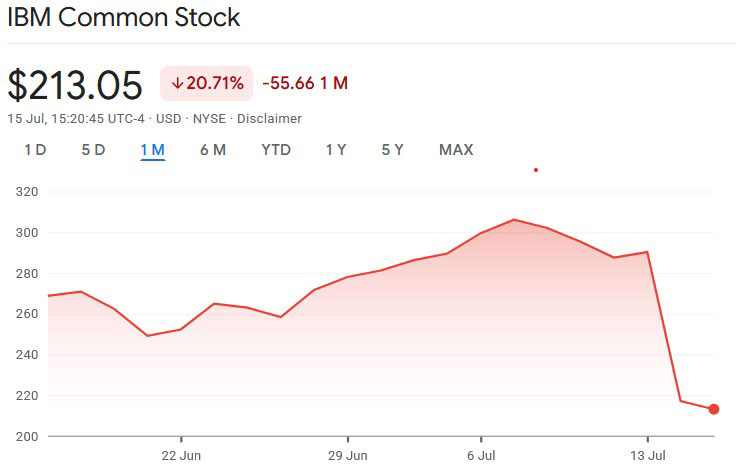
The plunge is absolutely vertiginous on the chart : the stock was still above $300 on July 7, and it ended the July 15 trading session around $215. In just over a week, a massive chunk of the company's valuation simply went up in smoke.
This quarter, we faltered. Arvind Krishna, IBM CEO
What Krishna half-admits is that IBM completely missed the sheer speed of this massive reallocation. Several massive deals could not be closed in time, and a large portion of clients chose to handle cybersecurity emergencies while putting long-term infrastructure contracts on hold.
The Great IBM Paradox : Selling Software in a Hardware-Obsessed World
For years, IBM has been trying to reinvent itself. They killed the image of the dusty old mainframe builder to become a next-gen software publisher. To achieve this, the company brought out the checkbook : Red Hat, HashiCorp, and more recently Confluent in December, presented as the perfect accelerator for generative AI.
And yet, the market just sent a brutal reminder : right now, AI primarily benefits chip and server manufacturers, leaving application software publishers behind. As long as the absolute number one priority for companies remains stacking raw computing power to train their models, software budgets will stay in the backseat.
The most ironic part of this story involves IBM's own hardware innovation. We previously talked about their 0.7 nm chip announcement with 100 billion transistors, promising up to 50% more computing power. In the current panic, other suppliers are simply sweeping the board on AI infrastructures, leaving IBM empty-handed.
This is certainly not the first time IBM trembles under the blows of AI. Back in February 2026, the stock already wobbled after Anthropic announced and demonstrated the extreme efficiency of Claude Code in modernizing old programming languages. This represents a direct threat to the massive maintenance revenues IBM pulls from its legacy systems.
What to Watch for Next
Two major indicators will determine if IBM can steer the ship back on course or if the slide will continue :
- Closing postponed contracts : IBM absolutely needs to finalize by the end of the year those massive deals that slipped through their fingers in the second quarter.
- Stabilizing the AI hardware cycle : Once the massive rush for servers and memory slows down, software and traditional infrastructure budgets should logically return to players like IBM.
See you on July 22, 2026 for the final Q2 earnings, which will provide a much clearer picture of the group's actual trajectory.
FAQ : What Everyone Is Wondering About the IBM Crash
Why did IBM stock crash by 25% in July 2026?
CEO Arvind Krishna warned investors a week before the official earnings that clients were massively redirecting their budgets toward purchasing AI servers and memory, heavily impacting IBM mainframes and services.
Is this the worst stock market drop in IBM history?
Yes, according to Arvind Krishna himself : this is the worst decline recorded by the company since at least 1972, surpassing even the sheer intensity of the October 1987 crash.
What is the connection between artificial intelligence and IBM's falling sales?
Companies are currently prioritizing physical hardware purchases, heavily focusing on high-performance servers and memory to train their AI models. This completely delays their investments in IBM's traditional software and infrastructures.
When is IBM publishing its full Q2 2026 earnings?
The final and official results are expected on July 22, 2026, exactly one week after Arvind Krishna's massive warning to investors.
The Verdict : Hardware is King, Software is on Probation
This massive air pocket for IBM acts as a giant wake-up call for the entire software industry. As long as the AI race remains a pure sprint for raw computing power, hardware will continue to lay down the law and capture the lion's share of investments. Personally, I firmly believe it is only a matter of time before the pendulum swings back the other way. Meanwhile, this is incredibly painful for the Armonk shareholders.
Do you think IBM will manage to bounce back by the end of the year, or does this quarter mark the beginning of a much longer downfall? Tell us in the comments!
💡 Join the community!
Want to debate about IBM, tech, or financial markets between two gaming sessions? Join us on the Little Big Campus Discord 👾