Ada Lovelace : The woman who programmed before her time (and before the computer)
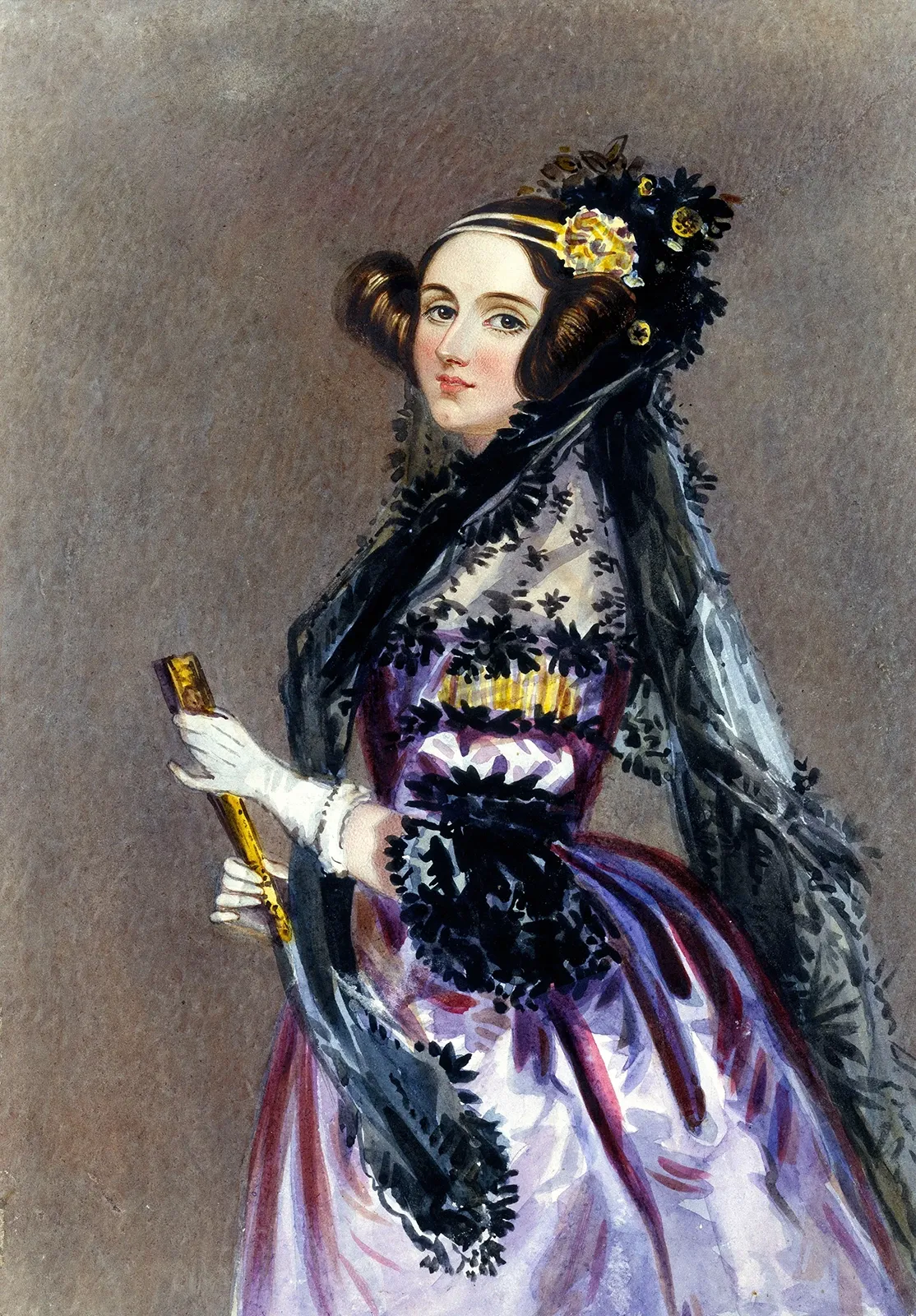
Imagine a girl, born in 1815, growing up in the shadow of a legendary but somewhat difficult father : the poet Lord Byron. Basically, the Pro of rhymes in his era, but also the man who left his family for epic (and less epic) adventures. Her mother, Lady Annabella Milbanke, a passionate mathematician, had one obsession : to prevent Ada at all costs from becoming a tortured poet like her father. The solution? Stuff the girl with math and science until she saw equations in her dreams. You know what ? it worked. And we probably owe her a great deal. That girl was Augusta Ada King, Countess of Lovelace, but to her friends (and to history), she is Ada Lovelace. And she wasn't just going to do additions. She was going to literally see the future of computing.
When Ada met Charles Babbage : a dance of numbers
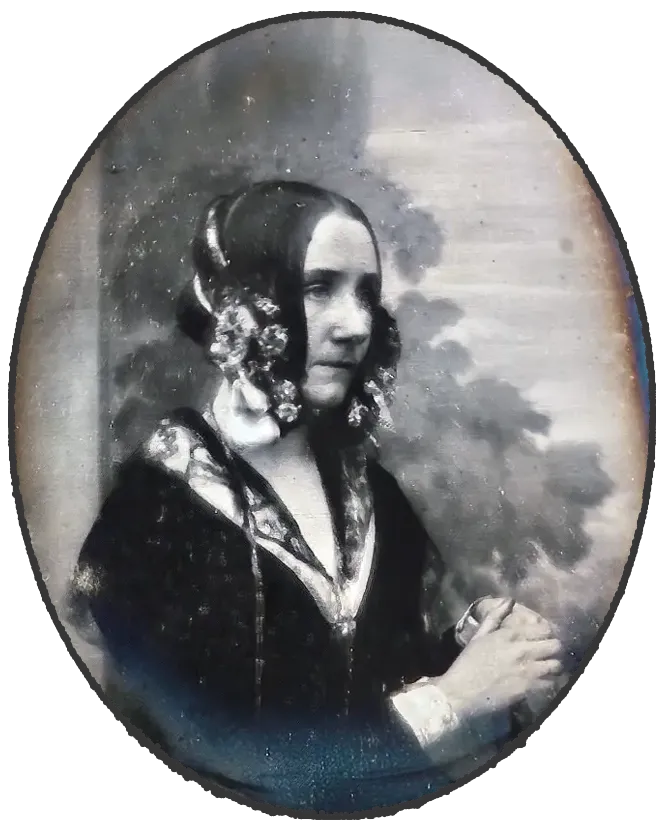
In 1833, at just 17 years old, Ada was invited to a social event where she crossed paths with a certain Charles Babbage (yes, our "Old Man Babbage" who was tired of calculation errors). He introduced her to his Difference Engine, that mechanical behemoth supposed to spit out perfect numbers. While most guests marveled at the gears or found it "fascinating but weird," Ada saw far beyond simple calculation. She was the only one to grasp the insane power of the Analytical Engine that Babbage would design later. It wasn't just a giant calculator; it was a machine that could be "programmed." And right then, something clicked.
The first "Hello World" in history, back in 1843
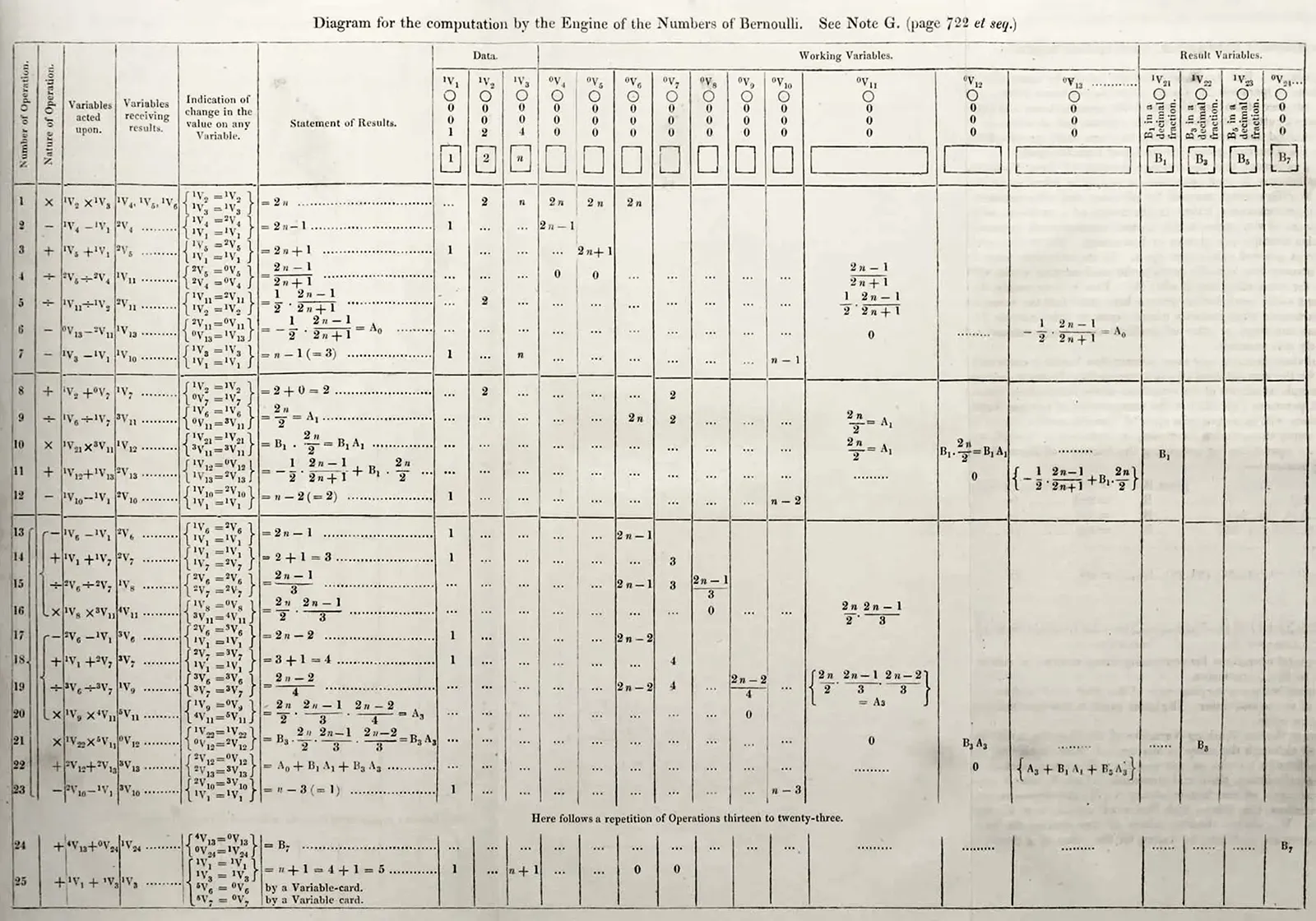
In 1842-1843, Ada was tasked with translating the notes of an Italian mathematician on Babbage's Analytical Engine. But she didn't just translate. She added her own "Notes," which were actually three times longer than the original article. And it was in these notes that she dropped the bombshell : the very first algorithm intended to be executed by a machine. We're talking about a program to calculate Bernoulli numbers! (Wait, what is he talking about?)
Don't worry, it's not rocket science! Let me explain.
Imagine a super repetitive and somewhat boring task : you have to add up numbers that follow each other, like :
- 1 + 2 + 3 + ... + a very large number (like 1 million)
- Or the same thing, but with squared numbers : 1² + 2² + 3² + ... + (1 million)²
- Or cubed : 1³ + 2³ + 3³ + ... + (1 million)³
Doing this by hand is hell. Even with a simple calculator, it takes forever. The thing is, in math, there are "magic recipes" to find these sums very quickly, no matter how large the final number is. These recipes are formulas.
Where do Bernoulli Numbers Come In?
Well, Bernoulli Numbers are like "secret ingredients" or "constants" found in these complex recipes. They are special numbers (often fractions, like 1/6 or −1/30) that allow the construction of a unique formula capable of calculating any sum of powers.
Why was this important for Ada Lovelace?
- Mathematical complexity : Calculating Bernoulli numbers is not trivial. It involves series, recursions, and repeated operations.
- Ideal for a programmable machine : It was an excellent case study to demonstrate that the Analytical Engine could do much more than simple additions or subtractions. To calculate these numbers, the machine would have needed to :
- Store values (memory).
- Repeat steps (loops).
- Make decisions (conditions, branches).
- Execute a complex sequence of operations.
By showing how the Analytical Engine could generate these numbers, Ada demonstrated its ability to execute a true complex program, and not just a chain of simple operations. It was the proof of concept for the "programmability" of the machine, which is the foundation of our modern computers. Ada Lovelace had just invented code.
She predicted Spotify and Photoshop before electricity
But Ada didn't stop at writing a program. She had a nearly mystical (or brilliant) vision of the Analytical Engine. While Babbage saw it as a number factory, Ada perceived that a machine could manipulate any symbol, not just numbers. She wrote : "The Analytical Engine might act upon other things besides numbers... for instance, if the fundamental relations of pitched sounds in the science of harmony... were susceptible of such expression and adaptations, the engine might compose elaborate and scientific pieces of music of any degree of complexity or extent." Basically, she predicted computer-aided music, image processing, and the idea that computers are not just giant calculators, but versatile tools capable of creating and manipulating any type of information. This was 1843, the era of the Great Migration across the American West.
A short life, an immense legacy
Unfortunately, Ada Lovelace died young, at 36 years old, in 1852, from cancer. Her work, like Babbage's, remained largely in the shadows for decades. The computer didn't exist yet; the world wasn't ready for what she had imagined. But her genius was not forgotten. Today, she is celebrated as the first programmer in history. The Ada programming language (created for the U.S. Department of Defense in the 70s) bears her name. Every year, the second Tuesday of October is "Ada Lovelace Day," to celebrate women in science, technology, engineering, and mathematics. She might have escaped the ghosts of her poet father, but she left an indelible mark, a kind of bug (a good one!) in the source code of humanity, showing us the way to a future where machines don't just calculate, but "think" (in their own way).
"She didn't invent the computer, but she invented the idea of what it could do."
Ada in pop culture?
She appears alongside Babbage in the game Assassin's Creed Syndicate. In another field, her name was used for the ADA programming language in the 80s. Today, the Cardano cryptocurrency also bears her name, as the currency is called ADA, and its smallest unit is called a Lovelace. Finally, the graphics architecture of Nvidia's RTX 4000 series is also named after Ada Lovelace. She can also be found in steampunk novels, TV series (like "Victoria" or "Doctor Who"), and she is an icon for women in tech, reminding us that the pioneers of computing weren't all men in suits and moustaches.