The Man Who Understood the Universe (And Left Us the User Manual)
Imagine a guy who, at age 6, was already performing multi-digit division in his head, snacking on dry biscuits, while the rest of us were just blowing bubbles in our milk.
By age 8, he spoke Ancient Greek just for fun. By 10, he was reading Laplace to relax. Welcome to the mind of John von Neumann, aka the man who literally drew the motherboard of digital humanity while everyone else was taking a nap. One of the most brilliant (and, let’s be honest, terrifying) minds of the 20th century. But here’s the thing : the world, once again, was not ready.
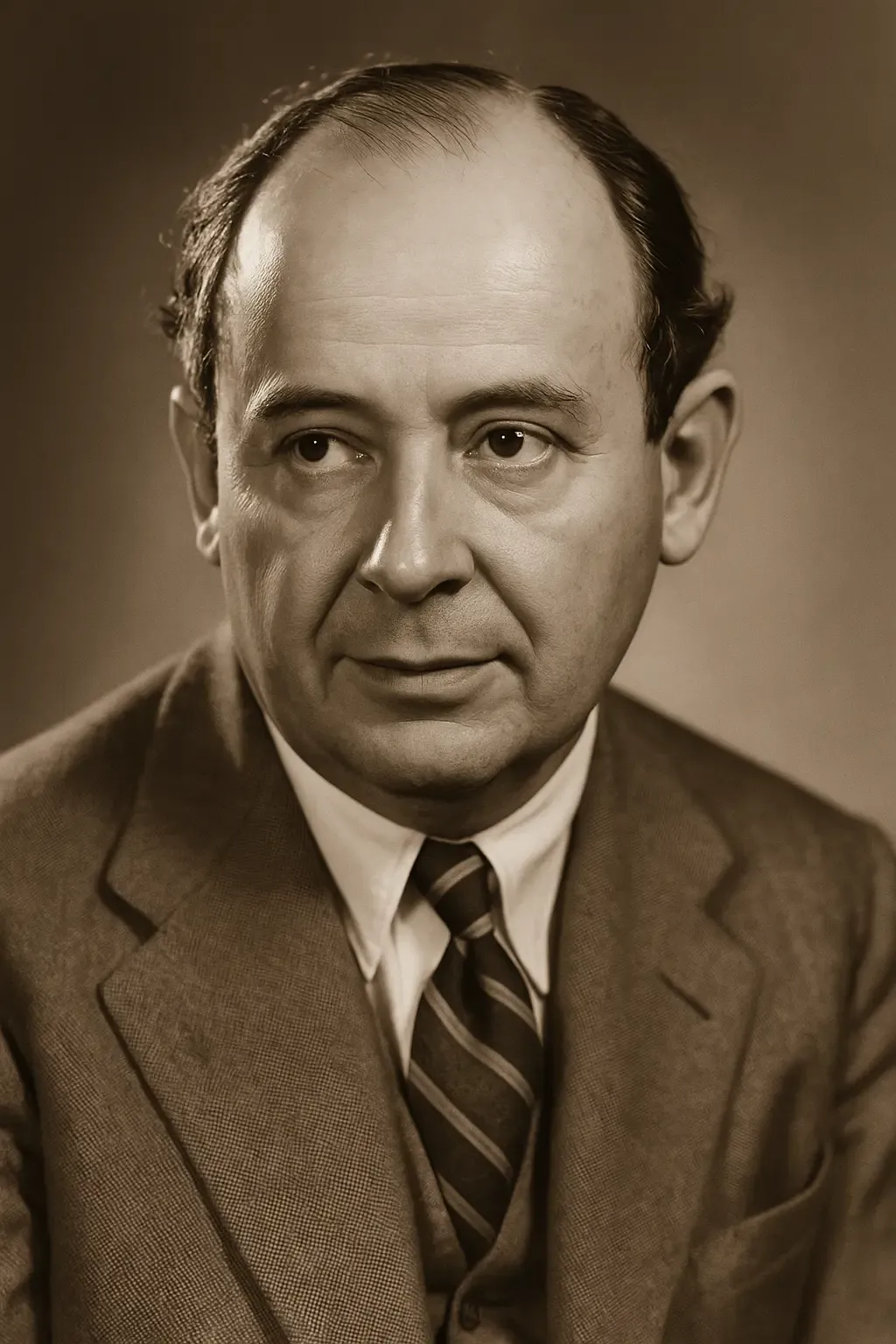
The Man Who Modeled Everything. Even Wars.
Born in 1903, in the Austro-Hungarian Empire (which we suspect imploded simply because he realized it didn’t deserve him), von Neumann quickly became the nightmare of ordinary brains. And professors. And mathematicians. And everyone else.
"In mathematics you don't understand things. You just get used to them." — John von Neumann
First, there's game theory. In 1944, von Neumann co-authored Theory of Games and Economic Behavior with Oskar Morgenstern. He formalized the strategic principles of "if I do this, he does that, so I’ll do this,"... A foundation for the Cold War, diplomacy, and your strategy in Warcraft III.
He Literally Invented the Modern Computer… Without Building It
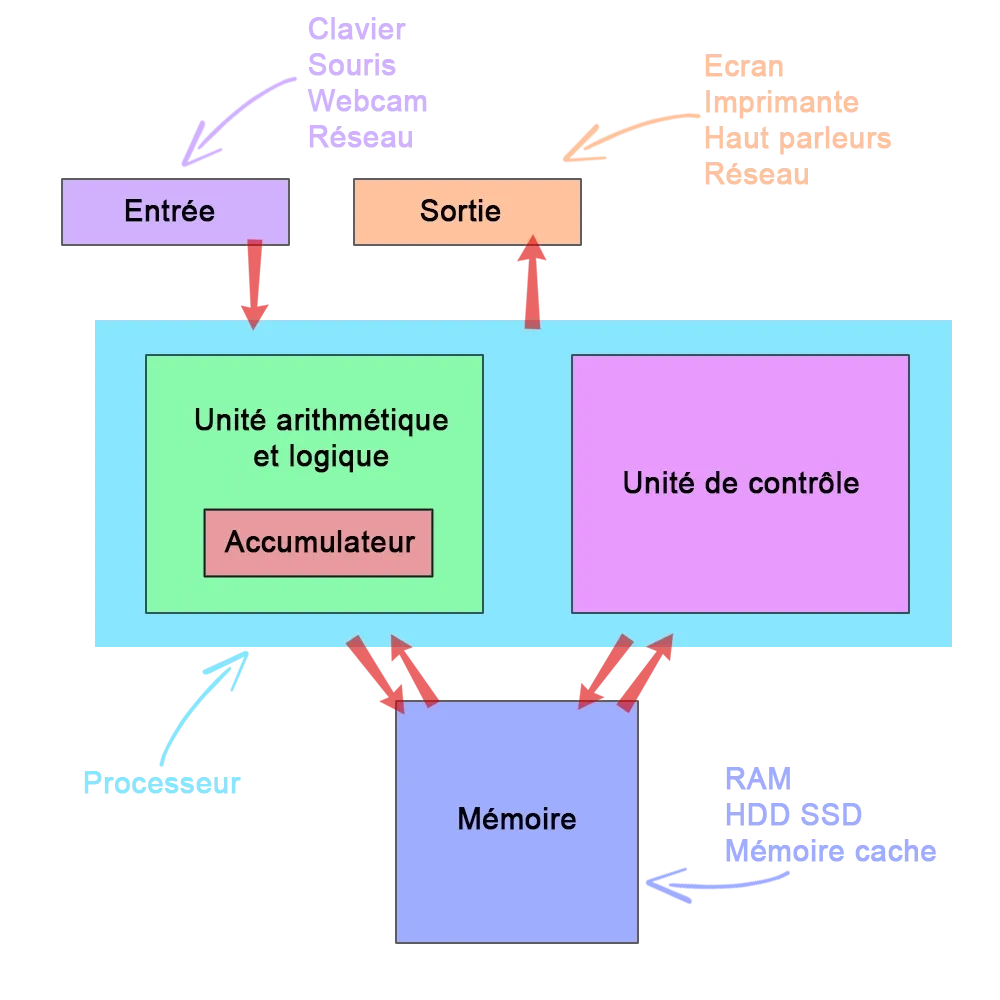
On the computing side, Neumann authored the first true model of a programmable computer : the famous von Neumann architecture. And it is more or less what we still use today in our PCs, our PS5s, and our phones.
Basically :
- A memory unit
- An arithmetic logic unit (to calculate)
- A control unit (to direct everything)
- Instructions stored as data (the revolution !)
Add a clock, a bit of RAM, and boom : the computer was born. In 1945, he published the First Draft of a Report on the EDVAC, a 101-page draft that serves as the founding blueprint for all modern computing.
Meanwhile, we’re still struggling to install a printer.
And for Good Measure, He Laid the Foundations of AI
In The Computer and the Brain (published posthumously in 1958), von Neumann attempted to compare the functioning of the human brain with that of a machine. He was already talking about :
- Neural networks,
- Self-organization,
- Machines capable of adapting.
He even imagined automata capable of self-replication. Literally. In 1951, he described an abstract machine that copies its own code — the ancestor of computer viruses, and the very idea of self-evolving intelligence.
So, even before the term AI was coined, he had conceived its theoretical structure. Let's not forget that he also laid the groundwork for the Technological Singularity. This is the theory that AI will undergo exponential growth, an "intelligence explosion," that will far surpass human intelligence and cause unpredictable changes in human society (for better or worse). It suggests that humanity could lose control of its own destiny. A vast subject, and more relevant than ever.
H-Bomb, Blast Height, and the MAD Doctrine
But that’s not all. Von Neumann was also a military consultant, working on :
- The Manhattan Project (the A-bomb),
- The development of the H-bomb (thermonuclear),
- Optimizing blast height to maximize impact (yes, he helped choose how many meters above the ground the bomb should detonate for maximum efficiency. Great stuff).
He reportedly told Truman : "If you say why not bomb [the Soviets] tomorrow, I say, why not today? If you say today at five o'clock, I say, why not one o'clock?"
This is where concepts like dominant strategy, Nash equilibrium, and later the famous Mutually Assured Destruction (MAD), or the "Balance of Terror," come from. This doctrine states that in a conflict, if one of the two belligerents pushes the red button, then the opponent will do the same. Today, this is what we call deterrence, where no benefit would be gained by either side, as both camps would be annihilated.
"If people do not believe that mathematics is simple, it is only because they do not realize how complicated life is." — John von Neumann
And von Neumann in Pop Culture Today ?
You think such a character would be forgotten ? Think again :
- He appears in Assassin’s Creed : Brotherhood, as a historical figure mentioned in the Abstergo databases.
- In Sid Meier’s Civilization VI, a building or Great Scientist can carry his name to boost research.
- He is regularly cited in science fiction, including The Peripheral (William Gibson), works by Greg Egan, or Neal Stephenson.
- The notion of a "von Neumann probe" has become a classic trope in Sci-Fi.
- And there are countless scientific articles, YouTube series, and modern essays paying him tribute.
Oh, and Google dedicated a Doodle to him in 2013 for his birthday.
The Legacy
John von Neumann died in 1957 at 53 years old from causes stemming from his nuclear research. Likely from cancer due to the radiation exposure he faced, and a growing pessimism about the potentially destructive consequences of his work. That's young. On his deathbed, he was constantly monitored by the military, for fear that he might reveal research secrets due to end-of-life treatments. But between 1925 and 1955, this man :
- Reinvented mathematics,
- Defined the foundations of computing,
- Proposed nuclear war strategies,
- Inspired artificial intelligence,
- Made jokes in Latin.
And like any good visionary, it took at least 30 years to understand half of what he said.
"There's no sense in being precise when you don't even know what you're talking about." — John von Neumann