War Never Changes : The First Cry of a Humanity on Its Knees
The year is October 1997. You are sitting in front of a trusty 486 or Pentium PC that hums like an old wood stove. Your desk is cluttered, and a cardboard box featuring a winking Vault Boy stares back at you with his signature facade of a smile. As the game loads, you hear the gravelly voice of "The" Ron Perlman whisper : "War. War never changes." In that moment, something clicks, a feeling difficult to explain to those who weren't there. Fallout 1, the original masterpiece from Interplay and Tim Cain, is far more than a video game. It is a defining cultural mark. An isometric post-apocalyptic RPG that thrusts you, alone, into a broken, irradiated Wasteland, devoid of humanity yet overflowing with gritty realism. Twenty-eight years later, I have completed five full runs. And every single time, that same gut feeling returns : "I’m going home."
▶ Play the music before reading. This article was built for it.
Fallout
Wasteland Soundtrack - Mark Morgan, 1997
⚠️ Soundtrack used for critical context — All rights reserved to Mark Morgan / Interplay
If you are looking for a classic PC RPG to rediscover in 2026, or if you want to understand why the Fallout franchise has spawned two seasons of an Amazon series, dozens of games, and a tireless community of fans, you are in the right place. This article is a tribute to my love for this game, covering everything from the deep lore to the hidden easter eggs, from the SPECIAL system to Mark Morgan's haunting score that chills you to the bone. Turn up the volume, settle in, and welcome to the desert.
The Genesis of a Masterpiece : How Fallout Was Born from One Man in His Office
Tim Cain : One Man, One Engine, One Vision
To understand why Fallout 1 is the way it is, we have to look back at the early 90s at Interplay Entertainment. A developer named Tim Cain began working alone on a game engine inspired by the GURPS tabletop role-playing system. He spent months coding in his spare time between official projects assigned by the studio. He was (and still is) a visionary building something in the shadows. Interplay nearly cancelled the project three times, fearing it was too "depressing" for the market. Tim Cain himself shares these fascinating anecdotes with disarming honesty on his YouTube channel, Cain on Games — a resource I highly recommend if you want to dive into the golden age of PC gaming.
Eventually, the team grew to about thirty people. The GURPS system was abandoned in February 1997 due to licensing constraints and replaced by a custom-built mechanic : the S.P.E.C.I.A.L. system (Strength, Perception, Endurance, Charisma, Intelligence, Agility, Luck). It was a revolutionary blend of Dungeons & Dragons and open-ended RPG logic where every stat influenced everything : dialogue, combat, diplomatic options, and NPC reactions. Fallout finally hit shelves on September 30, 1997.
🕹️ Did you know ? Tim Cain wrote the most famous line in Fallout history : "War. War never changes." It was his only direct contribution to the game's script, and it became the emblem of the entire franchise. He also recalls that upon his departure from Interplay, he was asked to destroy the source code, making any modern remaster project incredibly difficult today.
A Wasteland Inspired by the Best
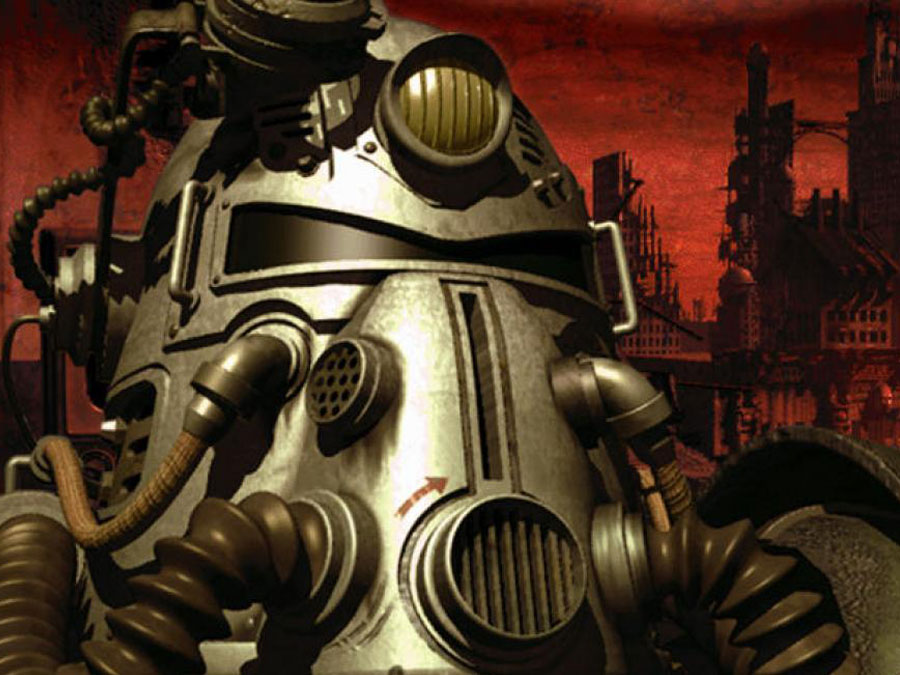
To craft the universe of Fallout, the team drew from very specific inspirations. Mad Max, naturally. Forbidden Planet. A Boy and His Dog. Frank Miller and Geoff Darrow's Hard-Boiled comic. And more unexpectedly, the film The City of Lost Children starring Ron Perlman, the same Ron Perlman who would narrate the saga's intros (for $50 and a sandwich). The result is a 1950s retro-futuristic world put through a nuclear shredder : an America that pushed atomic technology to the limit, wrapped in bakelite aesthetics and finned cars, right before the bombs fell. This contrast between a nostalgic, idealized Happy America that never truly existed and the absolute desolation of the post-war world has been the narrative heartbeat of the franchise since day one.
The Lore of Fallout 1 : Tales of a Broken World
2077 : The Bombs Fall, and the Aftermath Begins...
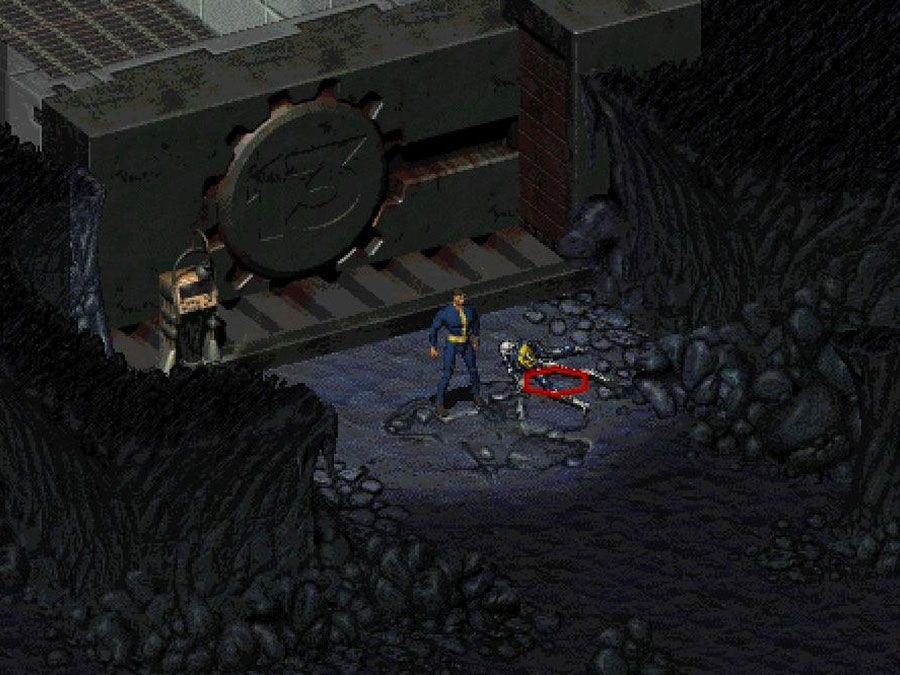
The story of Fallout 1 takes place in 2161, exactly 84 years after the Great War of 2077 wiped out civilization in two hours. You play as the Vault Dweller, a resident of Vault 13, one of the massive underground shelters built by Vault-Tec. Disaster strikes when the Vault's water purification chip fails, leaving only 150 days of reserves. The Overseer sends you into the unknown to find a replacement. It sounds simple in theory, but the Wasteland is a place where mercy is a luxury no one can afford.
What makes the lore of this first entry so dense is the looming threat hidden behind the primary quest. A Super-Mutant Army is scouring the desert, kidnapping humans. Orchestrating this is The Master, a horrifying human-machine hybrid who fused with an ancient computer system after falling into the FEV (Forced Evolutionary Virus) vats at Mariposa Military Base. The Master leads a mutant army with a singular goal : The Unity. He aims to transform all remaining humans into Super-Mutants to "unify" the species in this new world. To achieve this, he uses the Children of the Cathedral, a religious cult attracting followers in the ruins of Los Angeles, now known as The Boneyard.
💾 I played through the entire game with my close friend MaitreTréant at his place. We finally reached the final boss, The Master. My father had just arrived outside to pick me up, and I was already late. The tension was unbearable. That final rocket hit... we were playing on a 486 at 66 MHz... the PC chugged for what felt like an eternity right at the moment of impact. It was epic. I stayed until the very end before racing down the stairs. We still talk about that moment today.
The Master : The Greatest Antagonist in RPG History
The brilliance of The Master lies in the fact that you can defeat him without firing a single shot. If your Intelligence is high enough and you have discovered the correct FEV research reports, you can prove to him through dialogue that his Super-Mutants are sterile. You can show him that his "Unity" will never produce a sustainable new race and that everything he has built is doomed to vanish with the last generation of mutants. Faced with this undeniable truth, The Master... surrenders. He triggers the self-destruction of his Cathedral. This remains one of the most powerful moments of interactive storytelling ever produced, featuring an antagonist so well-written he can be overcome through logic and compassion.
Places That Speak of Collapse
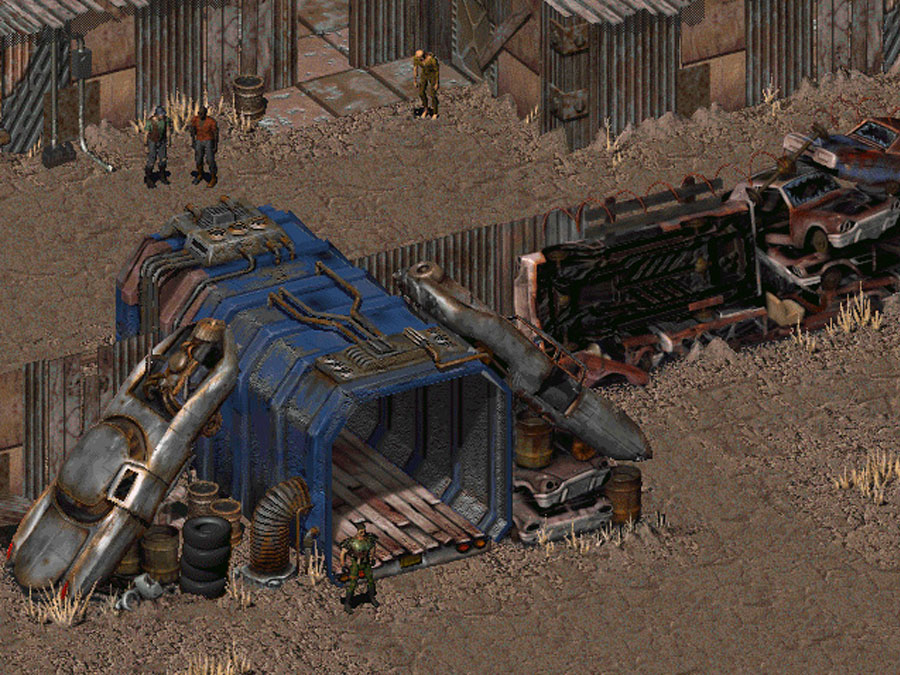
Shady Sands, the first settlement you encounter, is a struggling community trying to rebuild, raising brahmin (two-headed cows) and fearing Radscorpions. The Hub is a commercial crossroads teeming with merchants, criminals, and an underground economy fueled by Nuka-Cola bottle caps. Junktown teeters between gang rule and a makeshift mayoralty. Necropolis, the ruins of Bakersfield, is a ghost city inhabited by Ghouls — humans who absorbed too much radiation to die, but too much to remain normal. Then there is the Boneyard, the skeletal remains of L.A., where highway overpasses loom over gangs fighting for the scraps of civilization. Every location has its own story, its own factions, and its own secrets.
Mutations of the Living : Nature Adapting to the Worst
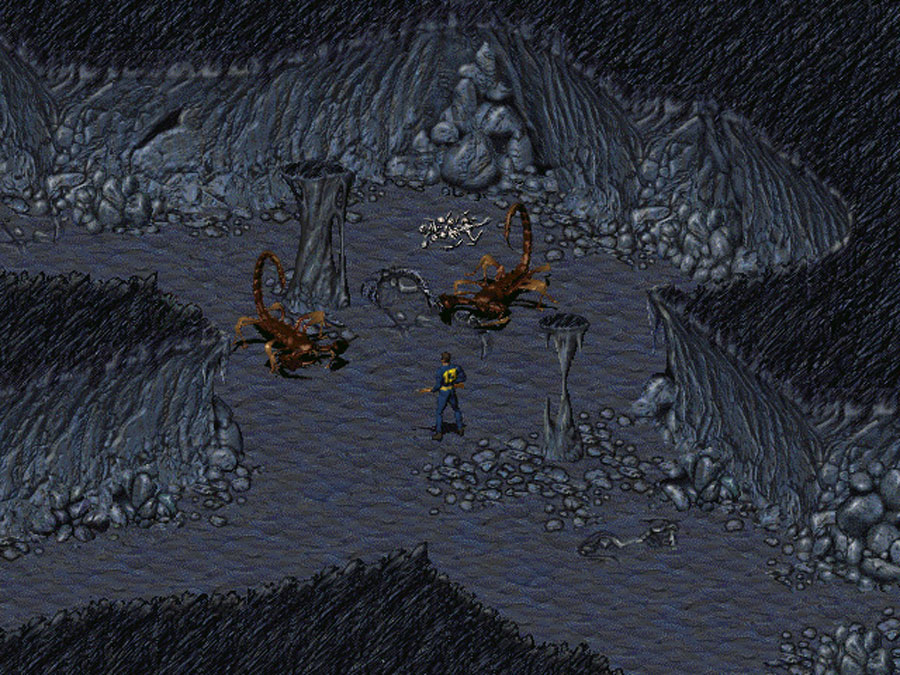
In Fallout 1, I’ve always been struck by how the game shows that life persists. The toughest species have mutated ; the rest have vanished. Radscorpions are huge, aggressive, and radiation-resistant. Brahmin, the two-headed cows, provide meat and milk. Giant Rats infest basements and sewers. Deathclaws are apex predators born from lizards modified by the FEV. And of course, the Ghouls and Super-Mutants serve as living witnesses to the erasing of humanity. The Wasteland isn’t empty ; it’s full of things that want you dead or people who have forgotten how to live any other way.
Gameplay, Tech, and PC Specs : Why Fallout 1 Was a Gaming UFO
The S.P.E.C.I.A.L. System : A Quiet Revolution
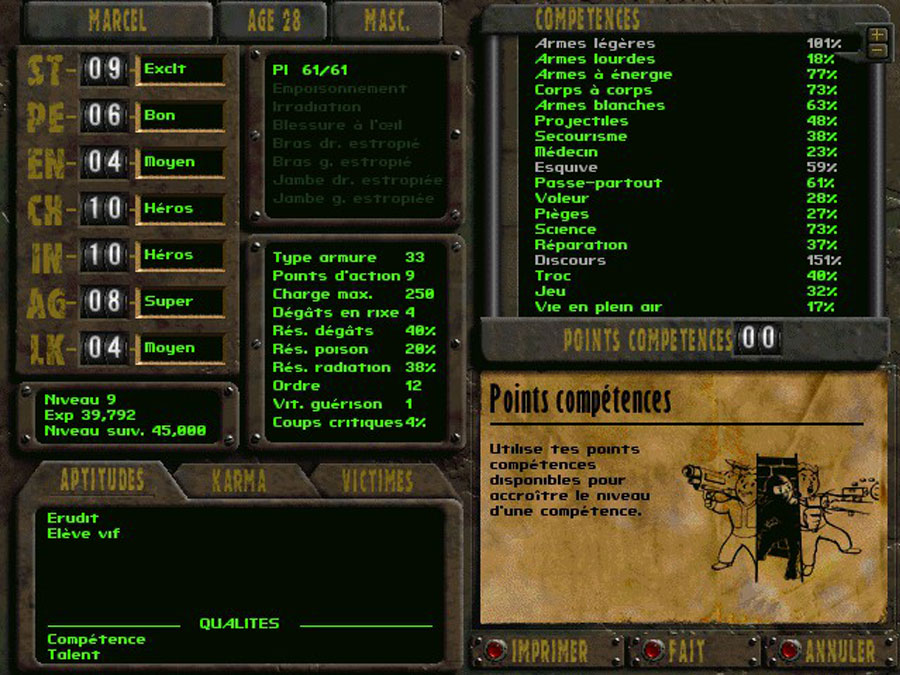
The heart of the game is its character system. S.P.E.C.I.A.L. stands for Strength, Perception, Endurance, Charisma, Intelligence, Agility, and Luck. These seven attributes, scaled from 1 to 10, dictate every interaction. A character with an Intelligence of 3 can barely form coherent sentences. A character with high Charisma earns discounts and unique dialogue options. This is the true freedom of Fallout : you can finish the game in dozens of ways. As a heavy-hitting brute, a pure diplomat who never kills, a saboteur, or a ghost who steals and dodges without ever being seen.
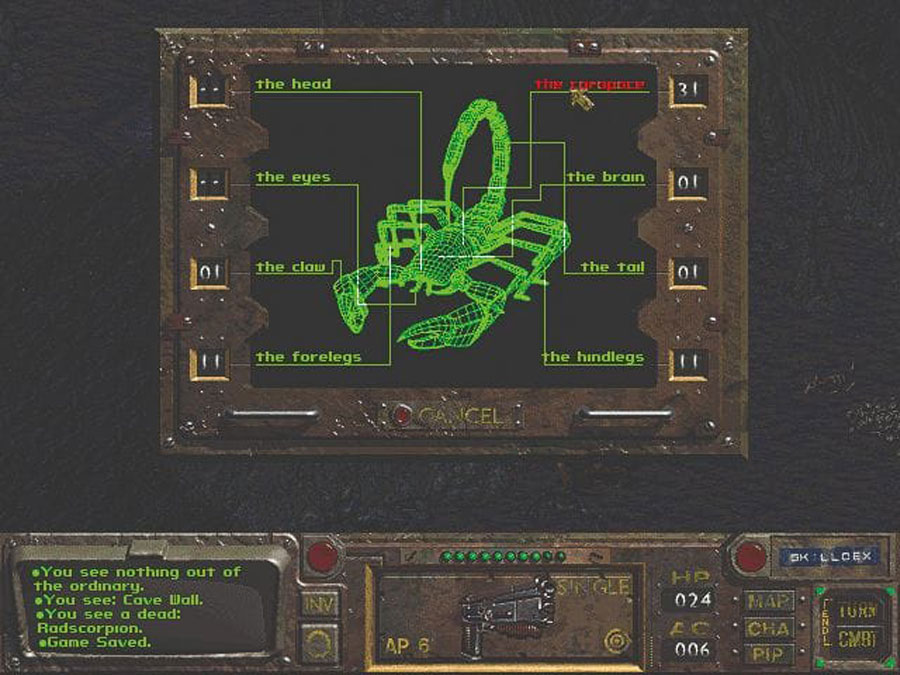
The V.A.T.S. (Vault-Tec Assisted Targeting System) adds a satisfying layer of tactical depth to turn-based combat. You can target specific body parts : aim for the legs to slow an enemy, the arms to force them to drop a weapon, or the eyes to blind them. Each combat encounter becomes a tactical puzzle, especially on higher difficulties.
💡 Build Advice : For a first run, aim for at least Intelligence 8 and tag the Speech skill. You will unlock dialogue options that are otherwise impossible to see, including the ability to talk down The Master. Also, make sure to find Dogmeat in Junktown — he is your best friend in the desert.
Graphics and Tech : Isometric Class
Fallout 1 runs in 2D isometric view with hand-drawn sprites and tile-based environments. It’s the classic aesthetic of the great PC RPGs of the era. Rendered at 640x480, the characters are small but incredibly expressive, especially in their death animations and dialogue stances. The art direction by Leonard Boyarsky gives every screen a distinct personality. The Wasteland is never beautiful, but it is always authentic.
🕹️ Original Minimum Specs (1997) : 486DX4/100 MHz or Pentium 75 MHz processor, 16 MB RAM, Windows 95, 255 MB disk space, SoundBlaster compatible card. Recommended Specs : Pentium 120 MHz, 32 MB RAM. In 2026, the game runs flawlessly on any machine via Steam or GOG, aided by community patches that fix residual bugs and improve modern resolution support.
Mark Morgan's Score : A Soundtrack That Haunts You
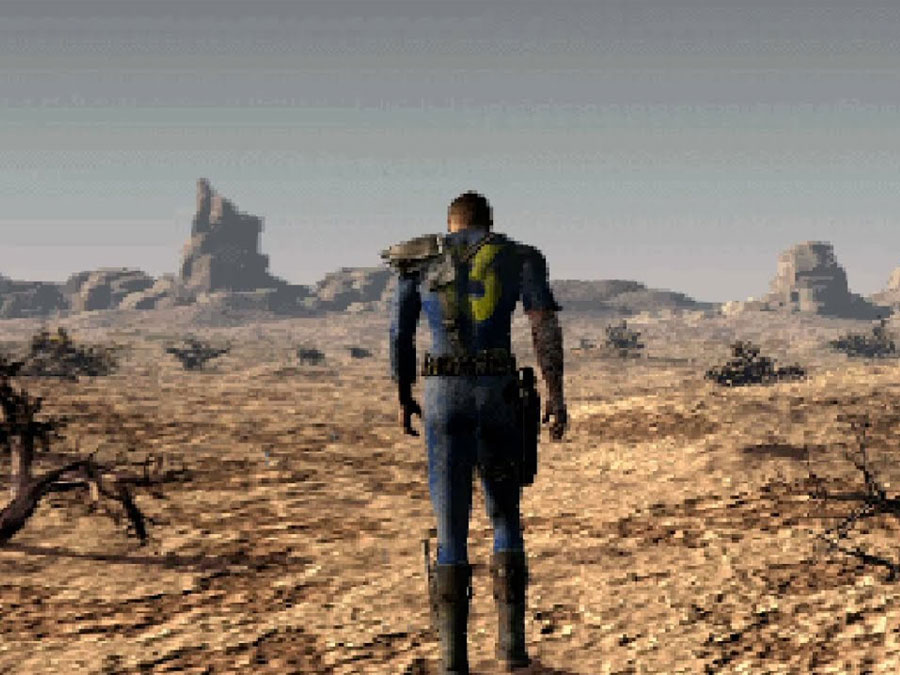
I cannot talk about Fallout 1 without mentioning Mark Morgan. The composer created something unique : a dark, industrial ambient soundtrack that is at times tribal and at others almost medieval. It clings to the Wasteland like a layer of radioactive dust. Tracks like "Radiation Storm" and "Moribund World" perfectly capture the desolation and the primitive regression of humanity. Some even compared it to Aphex Twin at the time, which was no accident : Tim Cain had given him reference CDs with the artist names removed. This creative misunderstanding produced a singular work of art. Mark Morgan also scored Fallout 2, and several of his tracks were later reused in Fallout: New Vegas because they are simply inseparable from the soul of the franchise.
Easter Eggs and Secrets : Where the Developers Hide
Tim Cain's Face in Your Taskbar
The most legendary easter egg in Fallout 1 : if you viewed the game icon in large size under Windows (a resolution few could afford in 1997), the radiation symbol was replaced by Tim Cain's face. He didn't put it there himself ; another programmer slipped it in as a secret. Tim Cain didn't find out until years later when players with better hardware began discovering it. In 2026, with high-res screens, this icon shows up by default on almost every system.
Boom, Headshot
On the Fallout 1 credits screen, type the word "boom" on your keyboard. You will see an animation of Tim Cain's head exploding, a hidden gift from the developers to themselves that remains in the game today.
The Tragedy of Dogmeat
Dogmeat, found in Junktown, is a direct nod to Mad Max 2. You can recruit him by wearing a leather jacket or giving him meat. Once he’s with you, he fights with suicidal courage. The problem is that Fallout 1’s companion AI lacks tactical awareness. Dogmeat has a habit of running into your line of fire, through force fields, or directly onto mines. Losing Dogmeat in the corridors of Mariposa remains one of the most devastating deaths in gaming history.
Ian and Friendly Fire
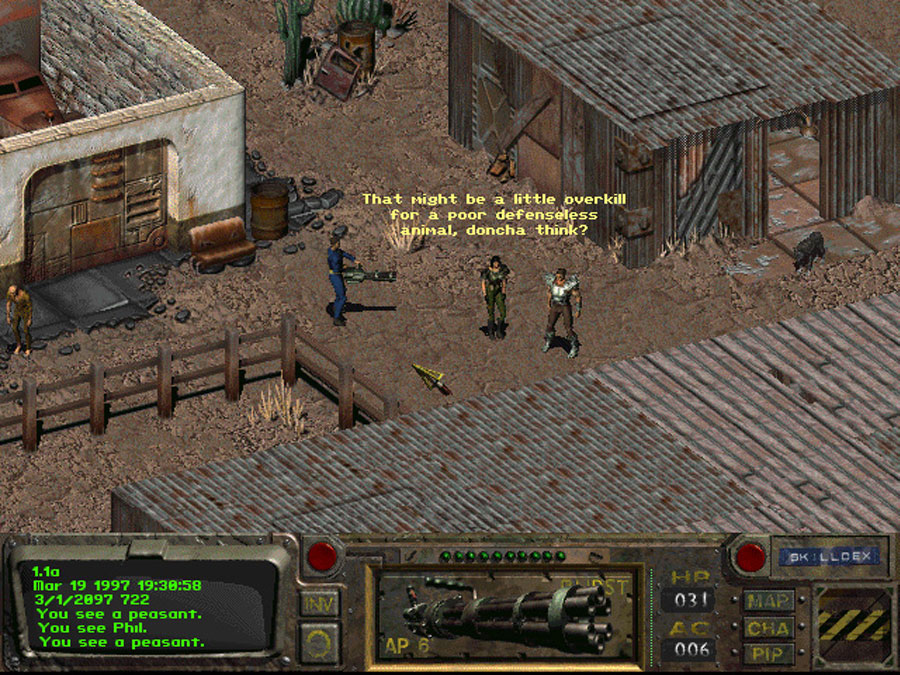
Ian, your first human companion from Shady Sands, is infamous for one thing : he will shoot you. Regularly. If you give him an automatic weapon, disaster is guaranteed. Never give Ian a burst-fire weapon. Never. The number of runs sabotaged by this man is legendary within the Fallout community.
"The game was originally scheduled for a summer 1997 release, but a memory overflow bug causing random crashes delayed it by several months. Tim Cain and his team worked like madmen to get it out in September. And the game was a massive hit."
What Fallout 1 Did to My Head, and Why I Never Recovered
A wasteland that lives inside people’s minds
Here is what very few games manage to achieve, yet Fallout 1 succeeds every time I return to it: making me feel true loneliness. Not the comfortable solitude of a player sitting in their living room, but the isolation of a world where all social codes have vanished. You encounter people wandering aimlessly, muttering incoherent fragments, people who literally have the same wasteland inside their heads as the one surrounding them. The trauma of the Great War is everywhere; it’s never explicitly stated, but it's present in the way NPCs speak, in their shifty eyes, and in their unpredictable reactions. The toughest survived. The weakest perished. And many others simply lost their minds completely.
There isn’t a single place in Fallout 1 where you feel like humanity made it through. It has literally disappeared. What remains are fragments, pieces of society held together by radioactive duct tape, people trying to recreate rules without remembering why those rules existed in the first place. Every encounter in the Wasteland can be bizarre, hallucinatory, tragic, or colored with a chilling black humor. But the landmarks are gone. That is a sensation I have found in almost no other game since.


The music that still echoes in my mind
I mentioned it earlier, but I want to dwell on it because it’s truly special. These tracks by Mark Morgan, experienced back then on a 486 or a Pentium with crackling desktop speakers, already had something unique about them. Today, with a decent pair of headphones, they pierce right through you. Radiation Storm starts with those low, heavy synth swells. Moribund World hits with its tribal percussion. City of Lost Angels sounds like a prayer for something that no longer exists. These are ambient compositions that establish a mood,a feeling of a world at a point of no return, without a single note of false hope. It blends so perfectly with what you see on screen that the whole experience becomes one monolithic block. That is what great sound design looks like.
What playing Fallout 1 actually feels like
You don't just play Fallout 1. You live it. You feel it. There are moments of absolute sorrow: the city of Necropolis, populated by Ghouls who no longer understand what they are : humans who became something else without ever asking for it. Children in The Hub (US version) from whom you can steal food if your morality falters. Quests that end badly no matter what you do. And then there are moments of black humor that almost hurt to laugh at. The developers understood something that many still miss today: in a world this broken, laughter and tragedy coexist constantly. That is what makes the Wasteland feel real.
And then, there is the ending. You save Vault 13. You destroy the mutant army. You return as a hero. And the Overseer, the man who sent you out there, exiles you. Because he is afraid... Afraid that your experience of the outside world, your ideas, and your freedom gained in the desert will contaminate the other Vault dwellers who have never seen the light. You saved your people, and your people cast you out. The heavy blast door slides shut behind you. The Vault Dweller walks back into the desert, alone. I never saw that conclusion coming the first time. I just sat there, in front of my screen, with nothing left to say.
💾 My brother, my close friends... we shared this game, replayed it countless times, watched both seasons of the show, and finished the entire franchise. Fallout 1 and 2 remain in a separate drawer for me, a cut above the rest. Not because they are the most beautiful or technically advanced, but because they are the most honest in what they say about humanity. For me, if you are a fan of the franchise or the Amazon series, you have to go back to the source.
A hypothetical world that demands reflection
Most of the time, developers create a game. Here, Tim Cain and his team created a world. A hypothetical world, granted, but one sufficiently anchored in human logic to make you think, hours after turning off the computer, that such a catastrophe isn't so impossible. Not the Super-Mutants. Not the FEV. But the logic of a world racing toward its own destruction for geopolitical and economic reasons, and the human behaviors that follow when structures collapse. That is why you don't just close the book on Fallout 1 easily. And if you want to see how these themes have crossed into popular culture through to the Amazon series, we wrote an article on Fallout Bakersfield, the FPS that resurrects Necropolis and truly extends this discussion.
Fallout 1: The Work That Proves Video Games Can Be Literature
In 2026, Fallout 1 is 28 years old. It still runs on modern machines for less than $5. Its community is still active, its quality-of-life mods are top-tier, and its themes are more relevant than ever. It’s not (just) out of nostalgia that I’m telling you to play it, or replay it. It’s because it is a foundational game in the truest sense: it laid down narrative, emotional, and mechanical foundations that dozens of titles have tried to imitate without ever quite succeeding. If you love the franchise, if you've seen the show, if you've played Bethesda's Fallout games and want to understand where it all truly began, Fallout 1 and 2 are your answer. We'll talk about Fallout 2 another time. And believe me, there will be just as much to say.
If Fallout 1 left a permanent mark on you too, or if this is your first contact with the franchise, let me know in the comments. I really want to hear your stories.
The journey is just beginning ! If you think you've seen everything the Wasteland has to offer, wait until you see how the sequel transcended every mechanic to become an absolute legend : Fallout 2 : Fallout 1 Unleashed and the Most Perfect Sequel Ever Made
💡 Join the community!
Want to talk about Fallout, retro gaming, or find friends to explore the Wasteland with? Join us on the Little Big Campus Discord 👾