If Fallout 1 left you shattered, if you stood up from your chair after watching the heavy blast door of Vault 13 close on the Vault Dweller, if Mark Morgan’s score haunted you for weeks... then you know exactly what you’re stepping into with Fallout 2. Released on October 30, 1998, and developed by Black Isle Studios in just eleven months, this second installment does more than just extend the saga. It unleashes it. It takes everything that was great about the first one and expands, densifies, and deepens it to the very core. It is the perfect sequel. The one the community has always compared to Baldur's Gate 2 : same DNA, same magic, but with an ambition and richness pushed to their absolute limit.
▶ Hit play before reading. The Wasteland demands it.
Fallout 2
Wasteland Soundtrack — Mark Morgan, 1998
⚠️ Soundtrack used for critical review purposes — All rights reserved to Mark Morgan / Interplay
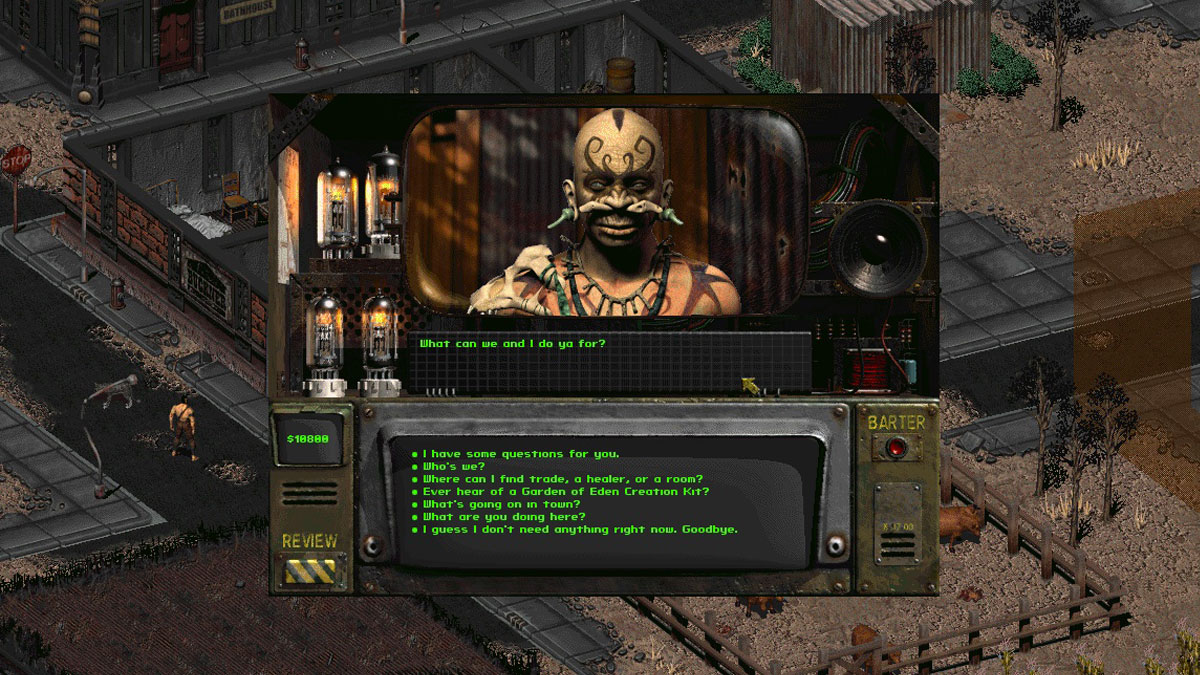
I have completed it five times from start to finish. And with every playthrough, I still discover something new. A hidden dialogue, a quest I had missed, a moral choice that makes me cross a line I swore I’d never touch. Fallout 2 is a game that tests you, and not just in combat. It will force you to prove your values, to make moral (or immoral) decisions. And it does so without ever lifting a finger, simply by asking the right questions on the screen, through an NPC dialogue, in the middle of a dark alley in New Reno.
The Genesis of Fallout 2 : Eleven Months to Outdo the Original
Black Isle Studios takes over the torch
When Fallout 1 hit the shelves in 1997 and became both a critical and commercial smash, Interplay immediately greenlit a sequel. However, Tim Cain, the father of the franchise, had never actually planned to make a Fallout 2. For him, the first game was a complete, standalone work. He still involved himself in the early development phases, writing the overarching narrative, inventing the Vault experiments concept, and laying the foundations for the expanded universe. He eventually left Interplay to found Troika Games with Leonard Boyarsky and Jason Anderson. The project then landed in the hands of Black Isle Studios, Interplay’s internal division, led notably by Chris Avellone, who would become one of the most brilliant writers in Western RPG history. Tim Cain shares these stories with visible honesty and passion on his YouTube channel, Cain on Games, which I highly recommend if you want to dive into the saga’s backstage.
The challenge was colossal : matching or even surpassing the original in just eleven months. Interplay was facing financial difficulties in 1998, the schedule was tight, and yet Black Isle delivered a game of staggering depth. The production pressure left its marks : unfinished quests, zones cut at the last minute, and truncated characters. But even in that state, Fallout 2 is larger, deeper, and more ambitious than its predecessor. And as we will see, the community took it upon themselves to repair what time had left hanging.
🕹️ The key stat : Fallout 2 was the best-selling game in the week of its release in the US, and according to Brian Fargo, it remains one of the most successful titles in Interplay's history. PC Gamer ranked it as the 3rd best RPG of all time in 2015. In 2026, 27 years later, its community is still actively modding the game.
The Lore of Fallout 2 : You Carry the Vault Dweller's Blood
Arroyo, the tribal village, and the quest for the GECK
Fallout 2 takes place in 2241, 80 years after the events of the first game. You aren't an anonymous Vault dweller this time. You are the Chosen One, the direct grandchild of the Vault Dweller from Fallout 1. The one who saved the world, was exiled by his own, wandered the desert, and eventually founded a tribal village : Arroyo. This village lives in a fragile harmony with the Wasteland, protected by canyons. But a drought has hit. The crops are dying. The tribe is suffering. The healer Hakunin (part shaman, part scholar, part crazy old woman...) sends you on a quest for a legendary artifact the elders call the GECK, the Garden of Eden Creation Kit. A pre-war device designed to transform any barren wasteland into fertile land. For Arroyo, this is about survival. You head out into the Wasteland armed with a spear, a Pip-Boy, and your ancestor’s worn-out jumpsuit.
But as always in Fallout, nothing is simple. The quest for the GECK is merely the thread that pulls you through a world infinitely more complex and darker than anything you imagined when leaving the rope bridge of Arroyo. Because while you are searching, an invisible force is watching. And one day, when you return, your village is gone. It has been razed. The inhabitants have been abducted. A bloody message in the sand tells you that the Enclave has struck. Devastating...
The Enclave : The last of the United States, and the worst
This is where Fallout 2’s narrative hits the hardest. The Enclave isn't a faction of raiders or mad mutants. They are the United States Government. The survivors of the federal structures, hidden on an offshore oil rig in the Pacific Ocean, completely out of reach. President Dick Richardson rules over them as if the war never happened. Except the Enclave has a plan : modifying the FEV into an airborne pathogen capable of killing any human being genetically altered by radiation. That means, in practice, the entire population of the Wasteland. Ghouls, mutants, tribals, city dwellers, and Vault citizens who became "impure" by contact with the outside world. Everyone. The Enclave wants to start from scratch with its own "pure" members and rebuild America on the corpse of the Wasteland.
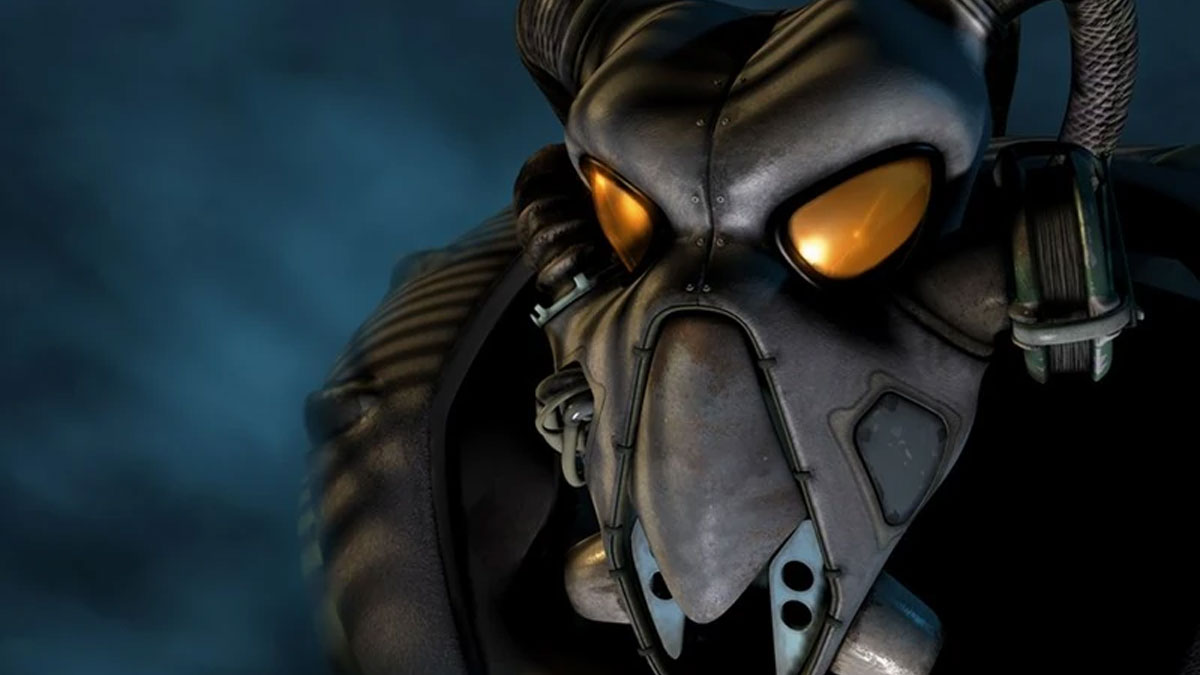
And to put this plan into action, they have Frank Horrigan. An Enclave Secret Service agent accidentally exposed to FEV during a mission at Mariposa, transformed into a colossal Super Mutant, and grafted into advanced power armor that also serves as his life support system. Horrigan is no longer human. He is the Enclave’s lethal power incarnate. You encounter him early in the game during a random event : he massacres a family of travelers without blinking. Then the camera pans back to you. That is the final boss. That is your enemy. I can tell you, when you cross his path, you feel very small indeed.
New Reno, the Post-Apo Reno : Where Vice Survives the Bombs
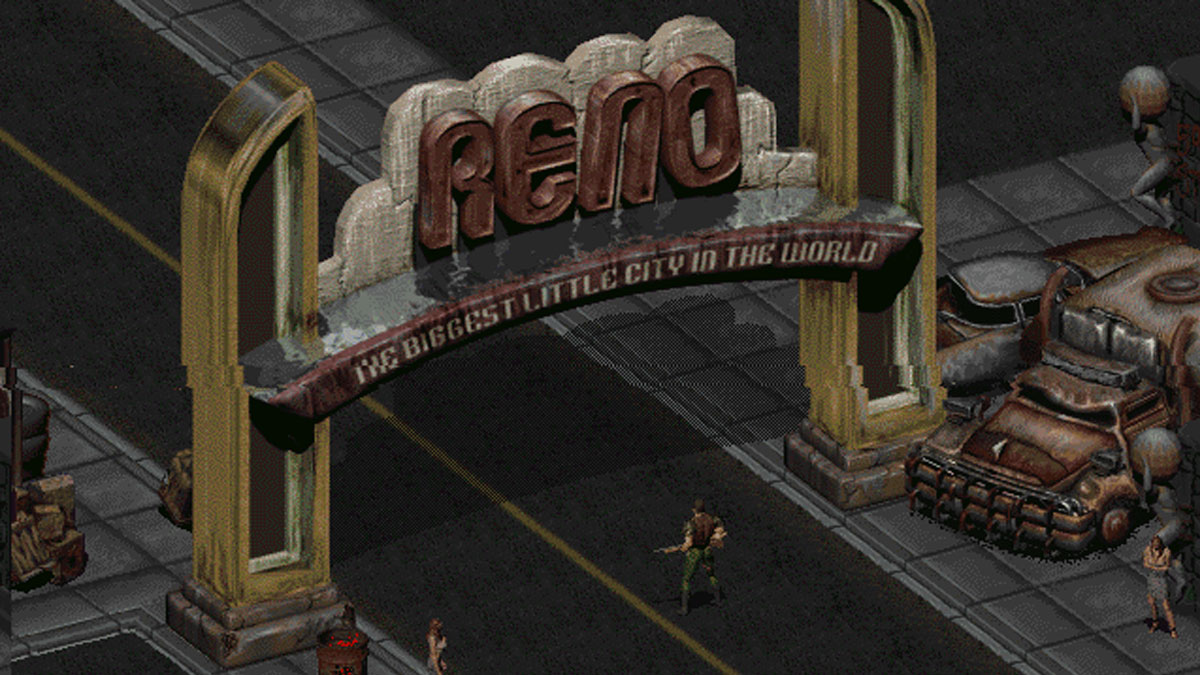
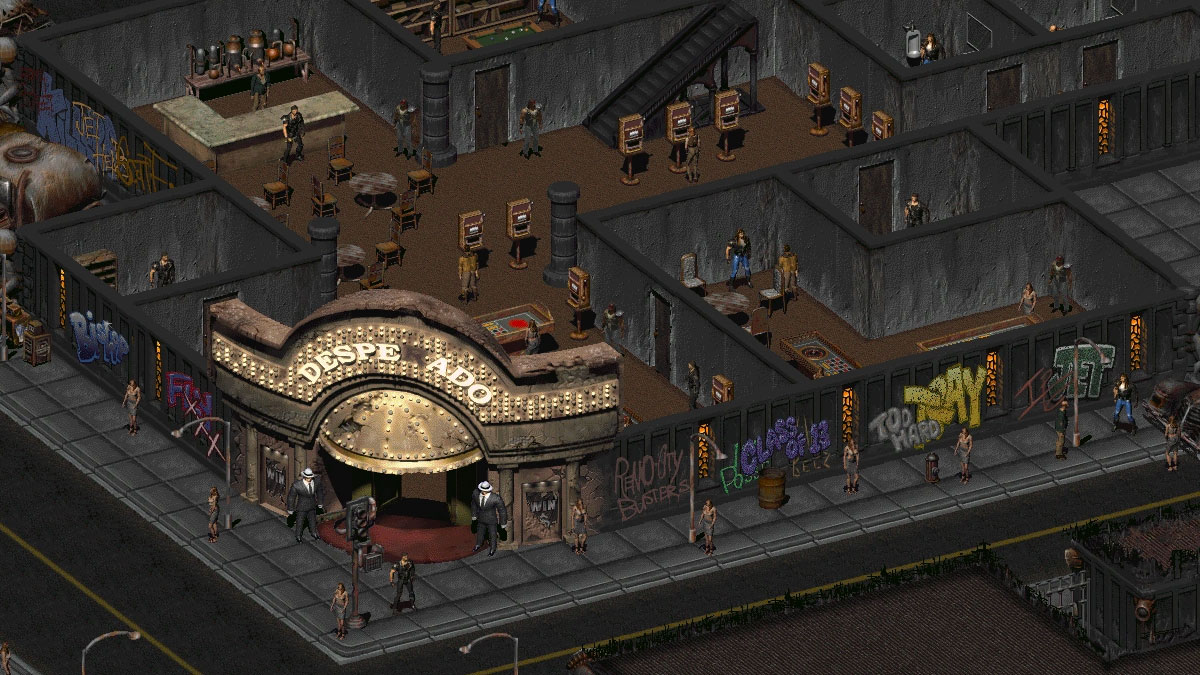
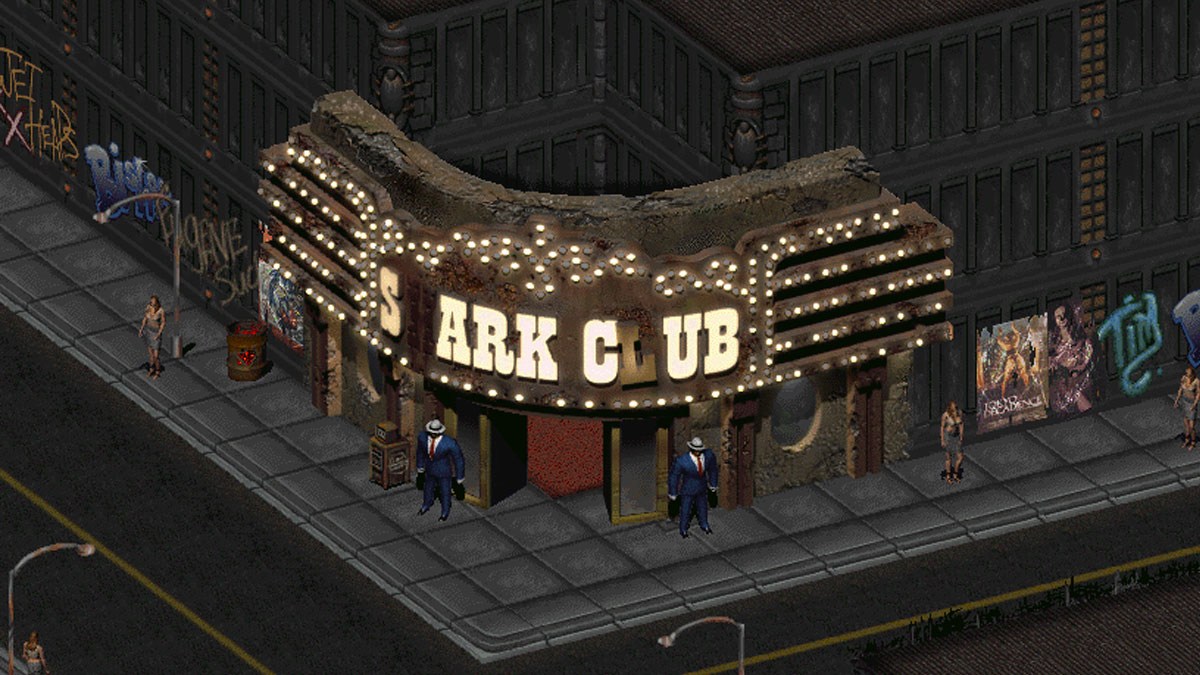
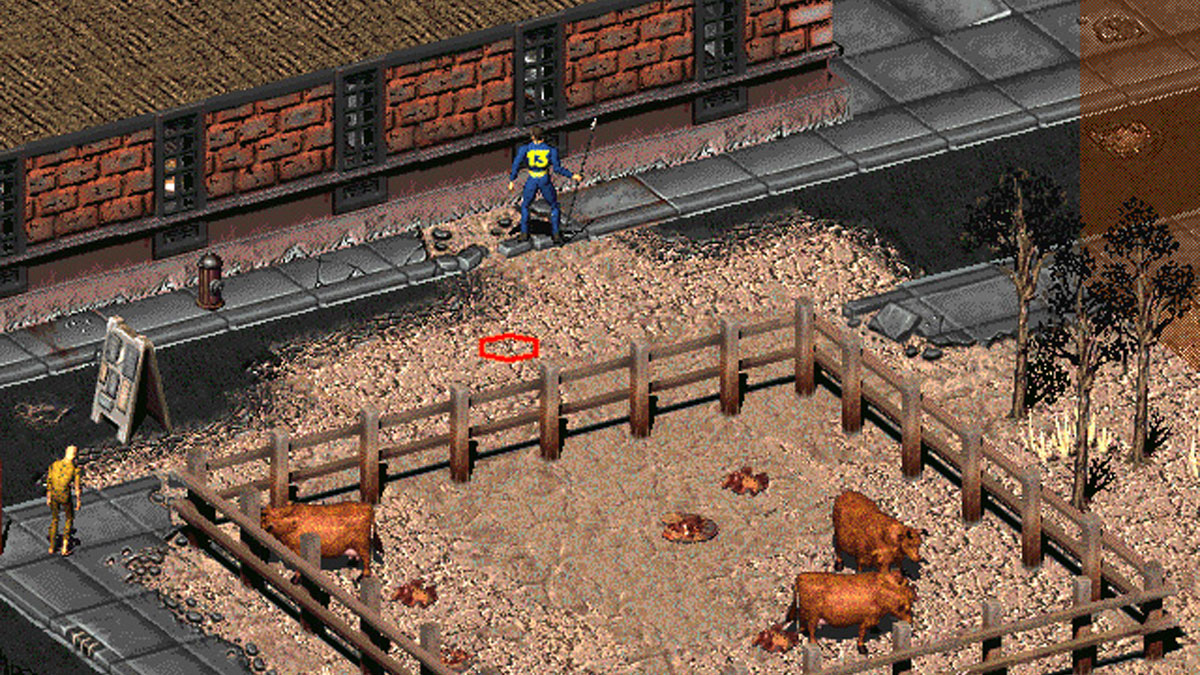
One of the greatest inventions of Fallout 2 is New Reno. A city that has no business being in a post-nuclear Wasteland... yet feels perfectly at home there. The real Reno, Nevada, was already known for its casinos and atmosphere of legalized vice. In the world of Fallout, protected by the surrounding mountains, it survived the atomic war and remains what it always was : a city of gambling, drugs, prostitution, and power struggles between four mafia families. The Mordinos, who control the production of Jet, an ultra-addictive synthetic drug created by a boy genius named Myron in his clandestine labs. The Bishops, powerful and calculating. The Wrights, more moral but not naive. The Salvatores, who have struck a secret deal with... the Enclave.
New Reno is an entire ecosystem. Hours of quests. You can become a boxing champion. Become a Made Man for a family. Solve a murder. Find the creator of Jet and force him to find an antidote. Or just lose yourself in the streets and watch this world function by its own rules : those of the Wasteland, where the strong rule and the weak are exploited. Chris Avellone admitted that New Reno took up a huge portion of his development time, and it shows.
Places that tell the story of 80 more years
Klamath, a town of gecko trappers and your gateway to adventure. The Den, a cursed town where orphans pick your pockets if you look away and drugs flow freely. Vault City, a seemingly perfect city, clean, organized, with green grass and pristine buildings. Except Vault City openly practices slavery and refuses to help anyone without a citizen's pass. Gecko, a ruined nuclear power plant run by Ghouls, whose reactor threatens to irradiate the whole region and fuels a cold war with Vault City. Redding, a mining town addicted to Jet, at the crossroads of major faction influences. Broken Hills, another mining town where humans and Super Mutants live in a fragile balance. And then the NCR, the New California Republic : the first sprout of organized government since the war, with its own political flaws. Finally, San Francisco, with two rival factions : the Hubologists, a grotesque post-apo cult, and the Shi, descendants of a Chinese submarine crew. The Wasteland is completely out of its mind, literally.
💾 Along with MaitreTréant, we also experienced Fallout 2 together. Same setup, same ritual. Two kids' heads in front of the same screen, debating every important dialogue. The first time we saw the Enclave land in Arroyo while we were exploring the world, only to find the village razed upon our return... a heavy silence filled the room. This game touches you where you least expect it.
Gameplay, Graphics, and PC Specs : Fallout 1 Pushed to the Max
The same engine, but everything is better
Fallout 2 runs on the same engine as the first game. Isometric view, hand-drawn 2D sprites, 640x480 resolution. The art direction is a direct continuation : the same tones of sand, rust, and cracked concrete, the same character animations, the same interface. It’s not a technical leap, but a deepening of what existed. And it was the right choice. The team didn't try to reinvent the wheel in eleven months ; they improved every detail within the existing frame. Death animations are even more expressive. Environments are more varied and dense. Character sprites were reworked for many NPCs. And most importantly : there is much more of everything. More towns, more quests, more factions, more companions, more dialogue, and more alternate endings.
On the QoL (Quality of Life) side, the game integrated several welcome improvements : combat animations could be sped up, navigation was slightly refined, and companions had a few more management options. It wasn’t perfect, but it represented real progress over the first game. In 2026, thanks to community patches and the Hi-Res Patch, you can play in 16:9, native full screen on any modern rig, with the mouse working perfectly. The game has never been so technically pleasant to play.
🕹️ Original Min Specs (1998) : Intel Pentium 90 MHz, 16 MB RAM, Windows 95, 2x CD-ROM drive, DirectX 3.0a, 1 MB VESA compatible SVGA graphics card. In 2026 : The game runs on any machine via Steam or GOG. Install the Restoration Project Updated (RPU) from GitHub and the Hi-Res Patch for the optimal 1080p or 4K experience.
The deepened SPECIAL system and even crazier builds
Fallout 2 keeps the full S.P.E.C.I.A.L. system and pushes it further. The traits system from Fallout 1 is enriched. Perks are more numerous and original. Skills have more applications in the world. Build freedom reaches its peak : you can play a character with 1 Intelligence, barely able to speak, and find specific dialogues written just for that. You can play a diplomat who never kills a soul. You can be a slave to a New Reno family, a Made Man, a prize fighter, a Jet dealer, a Brahmin rancher, or an NCR hero. You can even prostitute your spouse. Every run is a different experience.
The car is a major addition to this installment : the Highwayman, an old nuclear-powered car that saves you from crossing the Wasteland on foot. If you park it in New Reno and come back a few minutes later, it’s gone. Street kids stole it. You then have to track it down, following tire marks with your Outdoorsman skill, and recover the car from a chop shop. A moment that is both infuriating and brilliantly consistent with the universe.
Companions : A crew with grit and personality
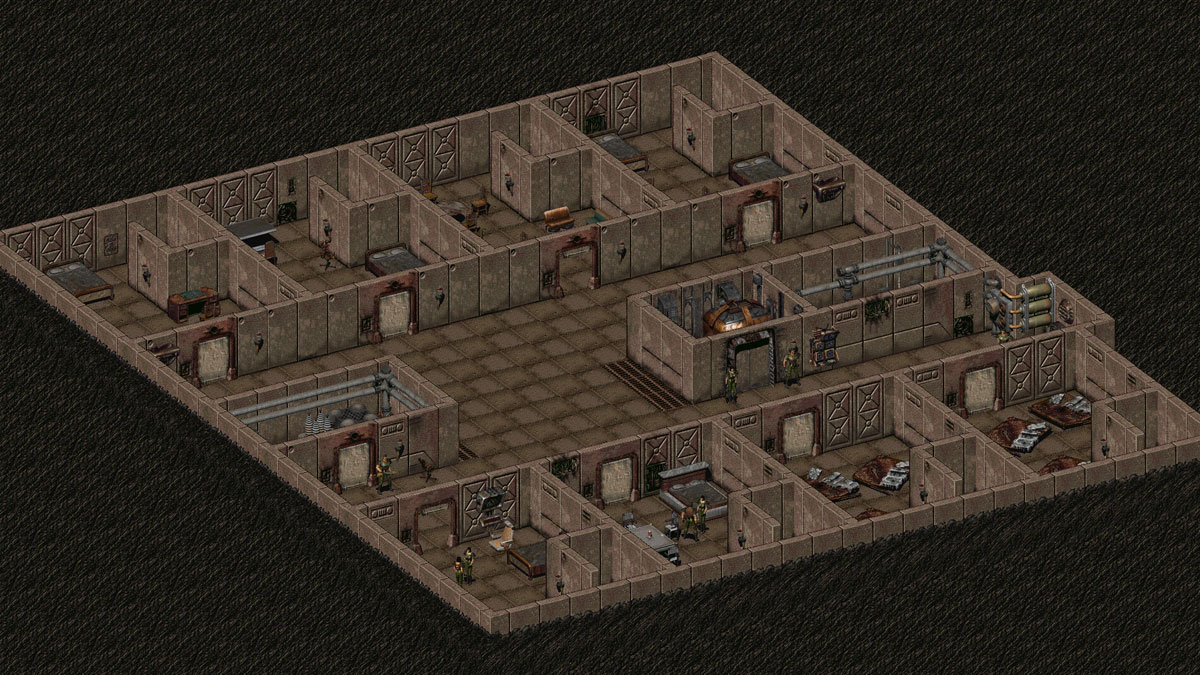
Fallout 2 pushed the quality of its companions much further. You gain access to characters with backstories, reactions, and unique dialogue depending on the context.
Sulik, the first you meet in Klamath, is an imposing tribal who consults ancestral spirits before giving you advice, often cryptic but strangely accurate. He starts the game searching for his sister, kidnapped by slavers. In the original version, this quest had no satisfying conclusion because the area where the sister was located had been cut. The Restoration Project restores it entirely. Cassidy, a whiskey-loving old bartender with a heart of gold, is a sharpshooter with his rifle and an accidental cardiologist since he suffers from a heart condition you can choose to ignore or manage. He sometimes looks at the map and says, "I wonder if Texas survived the war..." A line straight out of Red Dawn. Cassidy, for me, is one of the best NPC companions in RPG history. A character who has lived, who has scars, and who still chooses to walk with you through the hell of the Wasteland. Every time he got shredded in combat, I would reload a save.
There is also Myron, the boy genius who invented Jet for the Mordinos and joins you... only if you recruit him at his Stables in New Reno. A detestable, arrogant character who killed dozens of slaves testing his drug on them and doesn't feel a shred of remorse. If you don't kill him yourself, his ending in the credits mentions he dies stabbed in a Den bar by a Jet addict. That epilogue note summarizes all of Fallout 2 in two lines.
The Restoration Project : The Community Finishes What Black Isle Could Not
800 bugs fixed and entire zones restored
Fallout 2 was released with an impressive number of bugs, incomplete quests, and cut content. Black Isle had much bigger plans : a zone called the EPA (Environmental Protection Agency), an old underground base near New Reno with a zoo and robots. Sulik’s tribe, an entire area intended to conclude his personal quest. The Shi submarine in San Francisco. Quests linking Gecko and Vault City. Secondary characters with full narrative arcs.
The community responded with the Restoration Project, launched by a modder known as Killap. He spent years scouring the game's data files, original design documents, and developer comments to rebuild everything that had been planned. The result : over 800 bugs fixed, six major new zones including the EPA, dozens of restored quests, recovered dialogues, and reinstated alternate endings. In 2026, an updated version, the Restoration Project Updated (RPU), maintained by BGForgeNet on GitHub, continues Killap’s legacy. It’s compatible with community translations and available in French. A true "must-have" if you’re launching Fallout 2 today.
💡 How to play in 2026 : Buy Fallout 2 on Steam or GOG. Then install the Restoration Project Updated (RPU) from GitHub (BGForgeNet/Fallout2_Restoration_Project) and the Hi-Res Patch for native 16:9 play. Install the RP to explore everything Black Isle intended and that time had buried.
Fallout 2 Easter Eggs : The Most Meta Game of Its Generation
Blues Brothers, Terminator, Star Trek, and a literal egg
Fallout 2 is a festival of pop culture references, placed in the scenery with a lightness and humor that perfectly balances the darkness of the themes. When you recruit Myron in New Reno, the Chosen One says : "It's 106 miles to Arroyo, we've got a full fusion cell, half a pack of RadAway, it's midnight, and I'm wearing a 50-year-old Vault 13 jumpsuit." A direct reference to the Blues Brothers. Right in the middle of the Wasteland. Those who know, know.
In an Enclave level garage, you’ll find a holodeck, a direct nod to Star Trek. When the Chosen One encounters certain Den residents with the right companions, they quote Robert De Niro in Taxi Driver : "You talkin' to me?" The Cool Shades in New Reno give +1 Charisma because they are quite literally the coolest thing in the Wasteland. And in Klamath, if you ask "Whiskey" Bob about the town of Den, he replies : "You will not find a more wretched hive of scum and villainy." Star Wars, in a 1998 game, with the radioactive Wasteland as a backdrop.
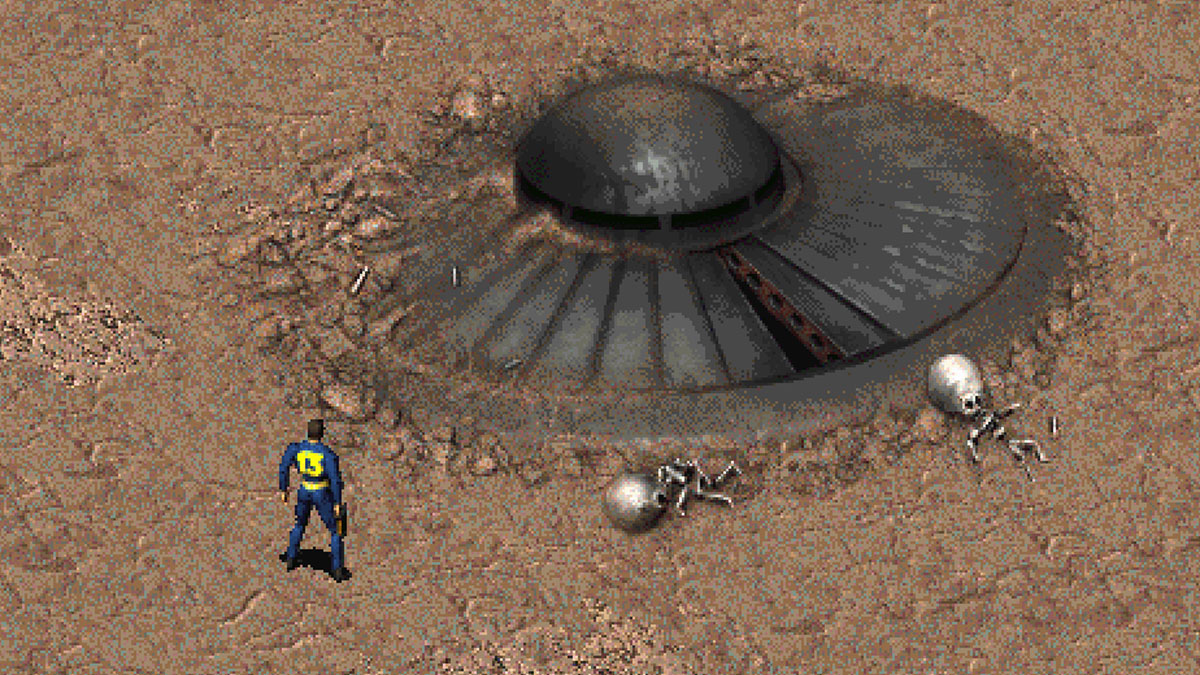
And then there is the literal easter egg : a special encounter where you find an egg in the desert. A real one. It does nothing. It’s just there so the development team could say there’s an easter egg in the game. Chris Avellone confirmed this in the Fallout Bible with a smirk in his voice. Finally, the crashed UFO, another special encounter with its two gray bodies and its Alien Blaster—the most destructive weapon in the game, placed there as if it were perfectly normal.
Calling the Enclave from the Gecko reactor
One of the funniest moments in all of Fallout 2 happens at the Gecko nuclear plant. By interacting with a certain maintenance robot and following a precise series of actions, the Chosen One can place a phone call to the Enclave base from the reactor. The soldier who answers has no idea what’s happening. He gets progressively angrier until he shouts : "The President of the United-fucking-States-of-America. Who'd you think I was talking about? Who the fu - Who is - What -" It is written with pure comedic talent. And it coexists, in the same game, with one of the darkest and most powerful endings in Western RPG history.
What Fallout 2 Makes You Feel, and Why I Never Found It Anywhere Else
The same desert, but even larger inside your mind
I said it for Fallout 1 and I’ll say it for 2 : there is a sense of loneliness in these games that I have found in almost no other title since. Fallout 2 amplifies this. The world is bigger, there are more people, more cities. And yet, you are even more alone. Because you carry the weight of your tribe on your shoulders. Because every person you meet in the Wasteland has wounds they lack the words to explain. People wandering aimlessly, with the same void in their heads as the desert around them. Trauma passed from generation to generation, a humanity that has forgotten what it once was, rebuilding social codes on ruins without always understanding why those codes existed.
Mark Morgan’s music evolved for this second installment, adding extra layers, electric guitar lines in tracks like My Chrysalis Highwayman that give the Wasteland an even stranger, more melancholic texture. The soundscape remains in the same register : dark ambient, tribal percussion, industrial drones, sounds that resemble nothing else and stick in your memory for years. If you’re reading this with the player running, you know exactly what I mean.
A hypothetical world that humbles you
What always struck me about Fallout 1 and 2 is that these games aren't just entertainment. They are a question asked aloud : what if ? What if the world’s greatest powers had continued their logic of over-armament to the inevitable end ? What if the structures of society truly collapsed ? What would be left of us ? Our laws ? Our values ? Or just our survival instinct, pushing everything else aside ? Fallout 2, by showing an NCR trying to rebuild a government while also showing all the corruption, compromises, and horrors that entails, asks this question better than any political essay. It is genre fiction in a $5 plastic box, yet it acts as political philosophy in motion. I don’t think the developers were even fully aware of it. But it’s there, and it has become a Major work of Video Games.
After all these years, with my brother, with MaitreTréant, and with close friends, Fallout 1 and 2 stay in a special place. We’ve played every game in the saga and seen both seasons of the show, we’ve been fans from the start. But these first two entries have something the sequels never quite recaptured. That gentle brutality, that naked truth of the world, that feeling of being truly lost and truly alive at the same time. Fallout 3 is magnificent. New Vegas is brilliant. But nothing equals the feeling of crossing that specific desert, in that specific world, with just a spear and a flickering Pip-Boy.
Conclusion : Fallout 2, the Sequel That Turned a Game Into a Universe
In 2026, Fallout 2 is 27 years old. It still runs for just a few dollars. Its community is as vibrant as ever, and the Restoration Project Updated is still receiving updates in 2025. Its core themes : power, corruption, survival, and the sacrifices societies make for their own longevity, are more relevant today than they have ever been. If you have never played it, 2026 offers the perfect excuse : the Amazon series has introduced millions of new fans to this universe. But the series, as brilliant as it may be, is only a reflection of something much deeper. The source is right here. In these two games, in this isometric and pixelated Wasteland, with Mark Morgan’s score echoing in your ears.
Fallout 1 and 2 are in a league of their own. They are games you don't just play : you live them, you feel them. And if you have wandered these wastes too, let us know in the comments. I truly want to read your stories.
Never experienced the opening act of this atomic epic? It’s not too late to dive into the masterpiece that started it all: Fallout 1: The Game That Taught Me What the End of the World Really Meant
💡 Join the community !
Want to talk Fallout, share your legendary runs, or find companions for the Wasteland ? Join us on the Little Big Campus Discord 👾