The Optical Illusion of Triumph : When General Magic Sold the Future to Wall Street Before Being Swallowed by the Internet
The year 1994 opens with an electric atmosphere in Mountain View. Sleepless nights, Apple's betrayal and the paranoia of the previous months have forged an exhausted team, yet one driven by an unshakeable conviction. The engineers at General Magic have won their bet : the hardware finally exists. The world will soon touch the future.
Yet, the history of technology is full of cruel ironies. Being right too early often proves to be the most dangerous curse.

The Vertigo of a Historic IPO
Even before consumers had time to adopt the devices, General Magic's management made a dizzying decision. In February 1995, the company went public on the NASDAQ. The event was unprecedented. The firm achieved the feat of raising massive funds with the backing of 16 distinct brokers : an absolute rarity for the era.
The IPO was a total triumph. The stock, initially offered at 14 dollars, soared and saw its value double on the very first day of trading. Wall Street was fascinated by the promise of this "Pocket Crystal" : the ultimate communication device.
The company instantly became one of the most highly valued startups in Silicon Valley, raking in tens of millions of dollars while having sold virtually nothing yet. Financial success acted as an anesthetic, masking the flaws that were beginning to threaten the structure.
A 14-dollar stock that doubles in a single day. Virtually zero sales. Wall Street was buying a dream. And General Magic sold it to them perfectly.
The Sony Magic Link and the Motorola Envoy : The Crystal Illusion
During 1994 and early 1995, partners from the Alliance of Titans finally deployed the devices onto the market. The utopia became material.
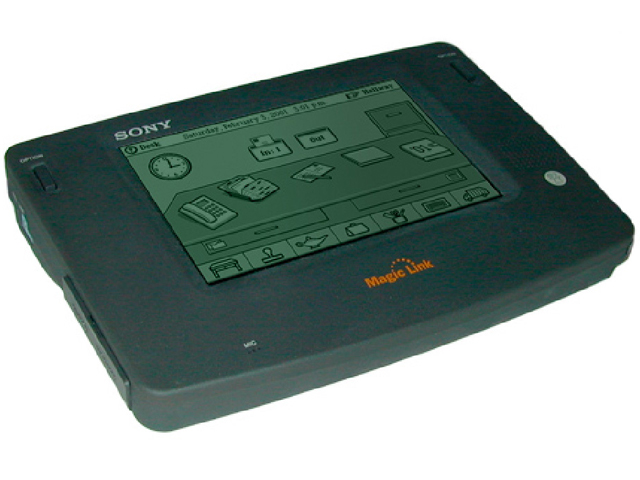

- The Sony Magic Link (PIC-1000) : a sleek device featuring a monochrome LCD touchscreen, a stylus, a built-in modem, and PCMCIA memory cards. Its interface, powered by the Magic Cap software, offered a revolutionary virtual desktop with drawers, a telephone, and even a virtual street to access third-party services.
- The Motorola Envoy : bulkier, it integrated a major innovation for the time : a wireless antenna allowing connection to AT&T's packet radio network.
The tech press praised the ingenuity of the interface. The General Magic engineers, led by Tony Fadell and Megan Smith, looked at their creations in shop windows with immense pride. The original goal of Marc Porat was achieved. The world of handheld communication was born.
⚠️ The material reality of 1994 : the interface aimed for fluidity, yet processors of the era were too slow to handle the demanding animations of Magic Cap. Communication was universal on paper, but 2400-baud modems forced endless waiting times. And the retail price neared 800 to 1000 dollars : a major barrier for any average consumer.
The Invisible Tsunami of the World Wide Web
While General Magic celebrated its stock market triumph, a colossal revolution was brewing behind its back. The fatal blow bypassed Apple's Newton entirely, emerging instead from a free, open, and completely unexpected technology.
General Magic had bet everything on Telescript : a closed proprietary network designed in exclusive partnership with telecom giant AT&T (the PersonaLink network). Marc Porat and his team imagined the future as a controlled and secure shopping mall.

Simultaneously, a researcher named Tim Berners-Lee was releasing the World Wide Web (HTML and HTTP) to the public. The appearance of the first browsers, like Mosaic and then Netscape, made the Internet accessible to the entire world. The Web was free, chaotic, and exponential, instantly sweeping away the concept of paid closed networks.

Andy Hertzfeld, one of the most brilliant minds on the team, summarized this fatal mistake with immense clarity :
“The Internet was a total blind spot for us. We were building a sophisticated proprietary network, while the entire world was shifting toward an open standard.” Andy Hertzfeld, co-founder of General Magic
💾 What strikes me about this sentence is that Andy Hertzfeld doesn't try to justify himself. He tells the truth, simply. They were so focused on their own network that they didn't look at what was being built right next to them, right under their eyes. It is human. It is tragic. And it can happen to the best of us.
The Deafening Silence of Consumers
The downfall was incredibly cruel. Sales of the Sony Magic Link and the Motorola Envoy turned out to be catastrophic. The general public of 1995 felt no need to send emails from the street. The personal computer (PC) dominated homes, and the standard mobile phone was more than enough for calls.
Devices piled up in warehouses. Industrial partners, faced with financial losses and the absence of a market, began to pull out one by one. Sony and Motorola abandoned ship. The stock price collapsed.
In the hallways of Mountain View, the laughter went quiet. The bunk beds were dismantled, and rabbits no longer ran through the offices. The utopia evaporated under the weight of unsold inventory and the overwhelming rise of the Internet. The team that believed they were invincible discovered the bitter cruelty of an absolute tech truth : designing the future is only half the battle ; the world must be ready to accept it.
They had invented everything. The touch interface, emojis, the App Store, the cloud. But the world of 1995 just wanted a phone that rang and a PC for the office. Nothing more.
In Part 4, we discover what happens to everyone after the shipwreck : the ashes of General Magic, and the immortal legacy this team left to the entire world without almost anyone knowing it.
Frequently Asked Questions About General Magic and the 1994-1995 Crisis
Why did the Sony Magic Link fail commercially?
The Sony Magic Link was technologically advanced but suffered from three major barriers : a retail price between 800 and 1000 dollars that was inaccessible to the general public, processors too slow to smoothly run the Magic Cap interface, and 2400-baud modems that made connections painfully slow. The arrival of the free Web immediately rendered its proprietary Telescript network obsolete.
What was Telescript and why did it fail against the Internet?
Telescript was the proprietary network language designed by General Magic to route data between connected devices via the AT&T PersonaLink network. It failed against the World Wide Web because the Web was open, free, and universal, whereas Telescript was closed and paid. The arrival of Mosaic and Netscape from 1993-1994 made the concept of a proprietary network instantly outdated.
When did General Magic go public and what happened?
General Magic went public on the NASDAQ in February 1995. The IPO was a meteoric success, with the stock doubling on its first day of trading from its initial price of 14 dollars. However, this financial triumph was backed by virtually no real sales. When catastrophic commercial results became clear, the stock price collapsed.
What is the link between General Magic and the arrival of the Internet?
General Magic was a direct casualty of the rise of the World Wide Web. The company built its entire strategy around a closed proprietary network just as Tim Berners-Lee was releasing an open, free protocol that would connect the world. Andy Hertzfeld himself admitted that the Internet was a total blind spot for the team while they were developing their products.
Where can I find the previous articles in the General Magic series?
This four-part series is available in full on Little Big Campus. Part 2 covers Apple's betrayal and the race against time from 1992 to 1994. The fourth and final part, detailing the aftermath and General Magic's enduring legacy, follows this article.
💡 Join the community!
Want to keep talking about these stories that changed the world, tech, pop culture, or video games? Join us on the Little Big Campus Discord 👾